
SKU: BRUC0017
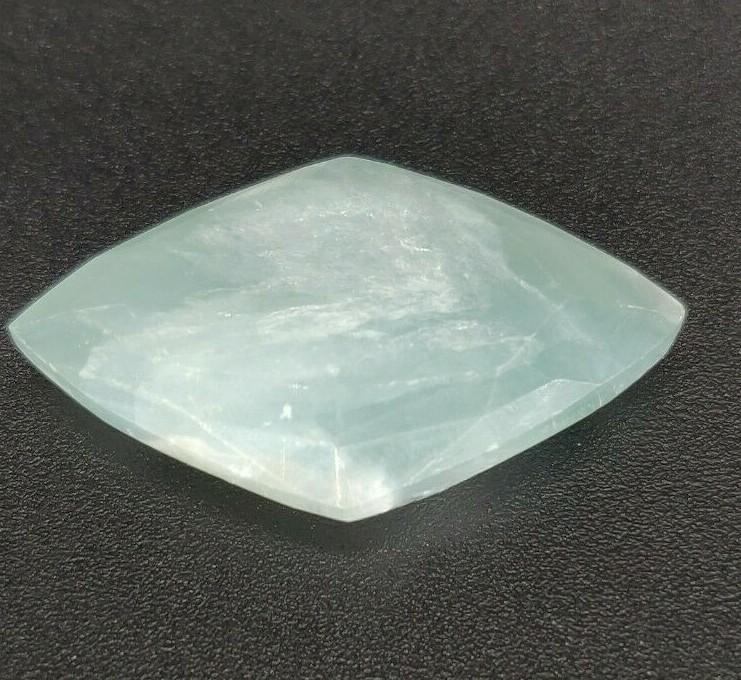
11.95 ct BRUCITE – RUSSIA
EXPERT VERIFIED
- Expert Verified Gemstone
- Fast Handling & Shipping
- Secure Vault Packaging
$ 200
Offer amount Feild


Smart Collector Choice


Pay with Crypto & Get 10% Automatic Discount

Availability: 1 in stock
Gemstone Details
Gem Variety:
Brucite
Origin:
Russia
Carat Weight:
11.95
Length (mm):
25.1
Width (mm):
14.4
Depth (mm):
6
Shape:
Marquise
Color
Blue
Treatment:
No Treatment
Certificate:
On Request
- Freakingcats Gemstone Database
Blue Brucite (Russia) Blue Brucite from Russia represents the "frozen sky" of the magnesium world. A magnesium hydroxide, it is a species I have always respected for its incredible color palette—transitioning from a soft "powder-blue" to an intense, "electric" azure that is almost unparalleled in the mineral kingdom. While Brucite is found globally in shades of white, yellow, or grey, the specimens from the Kulyumbe River region are a prize of vibrant translucency. For the specialist, Russian Blue Brucite is a study in "liquid" aesthetics; it often forms in delicate, micaceous plates or as "blocky," translucent masses that capture and hold the light. It is a stone of "crystalline calm," providing a sophisticated, high-frequency aesthetic that makes it a true "visual anchor" for the systematic vault. The Heritage & Discovery Historical Significance: Brucite has long been a vital mineral for industrial magnesium, but the Russian blue material elevated the species from a "utility" mineral to a "high-art" collector gem. Historically, the most famous Brucites were the "lemon-yellow" specimens from Pakistan, but the discovery of the Russian blue variety introduced a spectral cooling to the mineral world. In the world of fine minerals, it is celebrated for its rare pigmentation, which is believed to be caused by specific trace-element substitutions within the magnesium lattice. It stands as a symbol of serenity and structural refinement, bridging the gap between common metamorphic minerals and the elite world of "neon" color-saturated specimens. It serves as a reminder that even the simplest hydroxide structures can achieve a level of ethereal beauty when birthed in the unique geological environments of the Russian North. Discovery: The mineral was formally named in 1824 in honor of Archibald Bruce (1777–1818), a pioneering American mineralogist who first described the species. Scientifically, it is a magnesium hydroxide. Its discovery in the Kulyumbe River region of Siberia provided mineralogists with the first clear look at "massive" blue Brucite, helping to map the chemical diversity of the magnesium-rich "traps" and contact metamorphic zones. My own respect for this material is rooted in its pearly luster; the way the light reflects off the internal cleavage planes creates a "shimmer" that mimics the surface of a frozen lake. Since its identification, it has become a "must-have" for collectors who value "pure" color and high-translucency species. Important Mines: The undisputed world capital for the finest "electric blue" material is the Kulyumbe River (Kulyumbe Valley) in the Krasnoyarsk Krai, Russia. This remote location produces the legendary azure specimens that set the global benchmark. I also have a high regard for the pale blue varieties found in South Africa and the "shimmering" white crystals from the Wood’s Chrome Mine in Pennsylvania, USA. For the vault, I prioritize the Russian material for its unmatched color saturation and its "jelly-like" translucency. Mineralogical Profile Description: Brucite is a magnesium hydroxide that crystallizes in the trigonal system. It sits at a 2.5 to 3 on the Mohs scale, making it a very soft and delicate mineral that must be handled with extreme care to avoid scratching its pearly surfaces. It is characterized by its vitreous to pearly luster and its unmistakable "heavenly" blue coloration. One of its most identifying traits is its perfect basal cleavage, which allows it to be split into thin, flexible (but not elastic) flakes. It has a moderate refractive index ($n \approx 1.56$ to $1.58$) and a characteristic "light" feel ($SG \approx 2.39$). Because it is a product of the alteration of periclase or the metamorphism of magnesium-rich rocks, it is often found in association with Serpentine, Dolomite, and Magnesite. When I select a piece for the collection, I look for "even" blue distribution and a lack of the "greyish" zones that can occur in lesser material, as these highlight the sophisticated, three-dimensional geometry of the mineral's growth. It is a light, high-vibration mineral that offers a unique, "aqueous" beauty unlike any other hydroxide species. Chemical Formula: Mg(OH)2


