

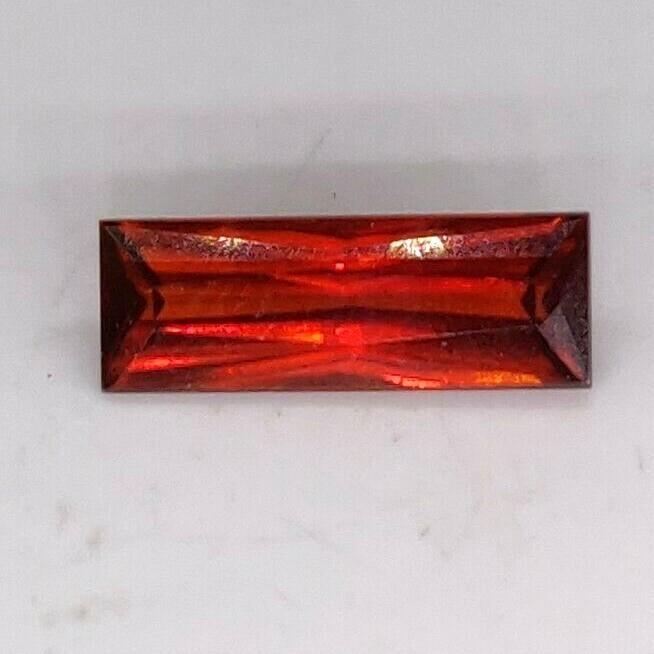
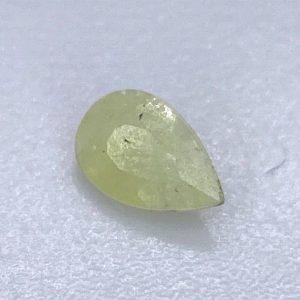
3.90 ct ZINCITE – POLAND
EXPERT VERIFIED
- Expert Verified Gemstone
- Fast Handling & Shipping
- Secure Vault Packaging
$ 350 Original price was: $ 350.$ 210Current price is: $ 210.
Offer amount Feild


Smart Collector Choice


Pay with Crypto & Get 10% Automatic Discount

Out of stock
- Freakingcats Gemstone Database
Zincite (Poland)
Zincite represents the “vibrant accident” of the industrial world. A zinc oxide, it is a species I have always respected for its “electric” saturation—ranging from a deep “ruby-red” and “burnt-orange” to a rare, “neon-yellow” and “forest-green.” While natural Zincite exists as a legendary rarity from New Jersey, the spectacular crystals from Poland tell a far more unique story. For the specialist, Polish Zincite is a prize of unintentional crystallization; it possesses a sub-adamantine luster and a high refractive index that gives faceted stones a “fire” and “glow” that is truly unmistakable. It is a stone of “serendipitous chemistry,” providing a sophisticated, high-energy aesthetic that makes it a “man-caused” treasure for the systematic vault.
The Heritage & Discovery
Historical Significance: Polish Zincite is a vital example of how industrial processes can inadvertently mimic the Earth’s most extreme geological conditions. Historically, this material was birthed in the massive smokestacks of a zinc smelting facility in Poland. When I was hunting Moldavites in the Czech Republic many years ago, I met a collector of tektites who showed me these incredible, colorful crystals. He wanted to test my knowledge, and of course, I had no idea about the material. I learned from him that he had personally harvested these crystals which came in many colors from the smokestacks of a company. During the production, somehow zinc-based smoke in the high smokestacks produced colorful crystals. These crystals had to be regularly cleaned out from the smokestacks. Later, the production method was changed and no more Zincite crystals grew, and they became very rare collectors’ items. It stands as a symbol of “industrial alchemy,” bridging the gap between waste byproducts and the elite world of “one-of-a-kind” collector gems.
Discovery: While this material is not natural, it is also not synthetic or lab-produced in the traditional sense, as they were created by a kind of production mistake or accident. I like to refer to them as “man-caused.” It is a fascinating material. No more rough has been available since the 1990s, and I am happy to have a small collection of the most amazing and rarest faceted Zincites to offer. My own respect for this material grew from its “accidental” perfection; the fact that such “liquid” clarity and intense color could form as a byproduct of heavy industry is a fascinating testament to the laws of chemistry.
Important Mines: The undisputed source for this unique, “smokestack-grown” material is the Silesia region of Poland, specifically from the chimneys of the Olawa or Miasteczko Slaskie smelters. While natural, non-industrial Zincite is found at the Franklin Mine in New Jersey, USA, those specimens are almost always opaque and lack the “gemmy” brilliance of the Polish “accident.” For the vault, I prioritize the Polish material for its unmatched “neon” saturation and its historical rarity.
Mineralogical Profile
Description: Zincite is a zinc oxide that crystallizes in the hexagonal system. It sits at a 4 on the Mohs scale, making it a relatively soft and delicate gem that must be handled with care to preserve its high-gloss surfaces. It is characterized by its sub-adamantine to vitreous luster and its unmistakable “flame-like” color palette.
One of its most identifying traits is its high refractive index ($n \approx 2.01$ to 2.03), which is significantly higher than most common gemstones, giving it an extraordinary “sparkle” and “depth.” It has a significant specific gravity ($SG \approx 5.6$), making it feel remarkably “heavy” in the hand for its size. Because it is an oxide, it is chemically stable but physically brittle. When I select a piece for the collection, I look for “water-clear” transparency and the rarest “green” or “yellow” hues, as these highlight the sophisticated, three-dimensional geometry of the mineral’s “accidental” growth. It is a dense, high-vibration material that offers a unique, “industrial-neon” beauty unlike any other oxide species.
Chemical Formula: (Zn,Mn)O
Related products
- Sale!Suggest a Price
![0.40 ct ANTHRACITE - USA]()
- Sale!Suggest a Price
![1.05 ct ANHYDRITE - MEXICO]()
- Sale!Suggest a Price
![7.06 ct ANHYDRITE - PERU]()
- Sale!Suggest a Price
![0.31 ct ADAMITE - MEXICO]()


