
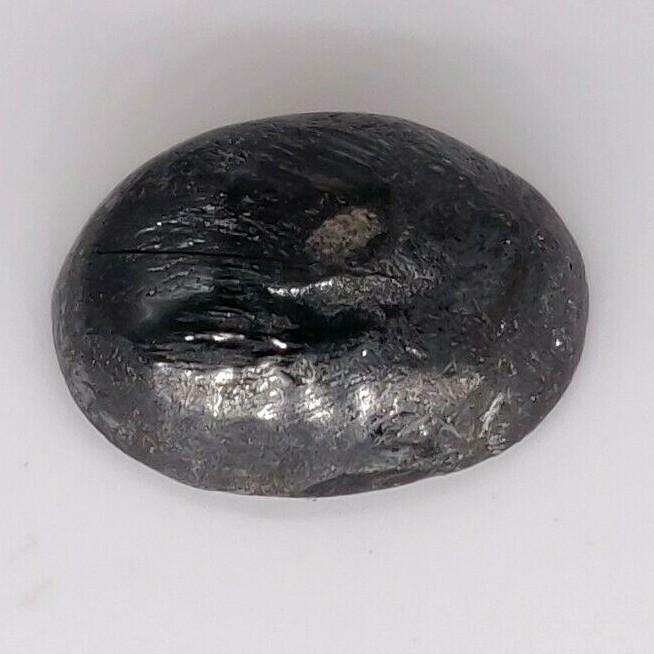
6.60 ct PYROLUSITE – MOROCCO
EXPERT VERIFIED
- Expert Verified Gemstone
- Fast Handling & Shipping
- Secure Vault Packaging
$ 120
Offer amount Feild


Smart Collector Choice


Pay with Crypto & Get 10% Automatic Discount

Availability: 1 in stock
- Freakingcats Gemstone Database
Pyrolusite
Pyrolusite is a mineral that captures the raw, unrefined power of manganese. While it is the most important ore of that metal, for a collector, it is a master of disguise. It can appear as massive, heavy metallic blocks, or as the delicate, “tree-like” dendrites often found branching across the surfaces of limestone—frequently mistaken for ancient plant fossils. I’ve always been drawn to its soot-black, metallic luster; there is a fundamental “earthiness” to it that reminds you of its ancient industrial history. Whether it is a sharp, prismatic crystal or a sprawling crystalline fan, Pyrolusite carries a dark, dense elegance that serves as a perfect anchor for any systematic mineral collection.
The Heritage & Discovery
Historical Significance: Pyrolusite has been used by humans for thousands of years, long before it was scientifically classified. Ancient cave painters used it as a black pigment, and for centuries, glassmakers used it as a “glass-soap” to remove the green tint caused by iron impurities. Its name literally reflects this history, derived from the Greek words pyr (fire) and louein (to wash), because of its ability to “wash” the color out of molten glass. It represents one of the earliest examples of human chemistry—the manipulation of mineral oxides to refine the aesthetics of our world.
Discovery: While its use dates back to antiquity, Pyrolusite was officially named and distinguished from other manganese minerals in 1827 by Wilhelm Karl von Haidinger. His classification helped mineralogists separate this primary dioxide from other similar-looking manganese ores like Manganite or Romanechite. It remains the benchmark mineral for the study of manganese oxidation zones.
Important Mines: Some of the most spectacular, well-formed crystals of Pyrolusite have emerged from the Imini Mine in Morocco, where it forms incredible, lustrous “star-burst” sprays. Another historic source is the Harz Mountains in Germany, which provided many of the type specimens for early European mineralogy. For those fascinated by the dendritic form, the Solnhofen Limestones in Bavaria are world-famous for producing the “fossil-lookalike” dendrites that are a staple of natural history displays.
Mineralogical Profile
Description: Pyrolusite is a manganese dioxide that crystallizes in the tetragonal system. It sits at a 6 to 6.5 on the Mohs scale, though in its massive or “sooty” forms, it can appear much softer and will easily soil the fingers with a dark gray streak. It is characterized by its sub-metallic to metallic luster and its deep iron-black to dark steel-gray color. One of its most interesting habits is “polianite,” which refers to the rare, distinct crystals that show the mineral’s true tetragonal symmetry, as opposed to the more common massive or fibrous forms. It is a dense, heavy mineral that is often found in oxidized manganese deposits and as a secondary product in hydrothermal veins.
Chemical Formula: MnO2


