

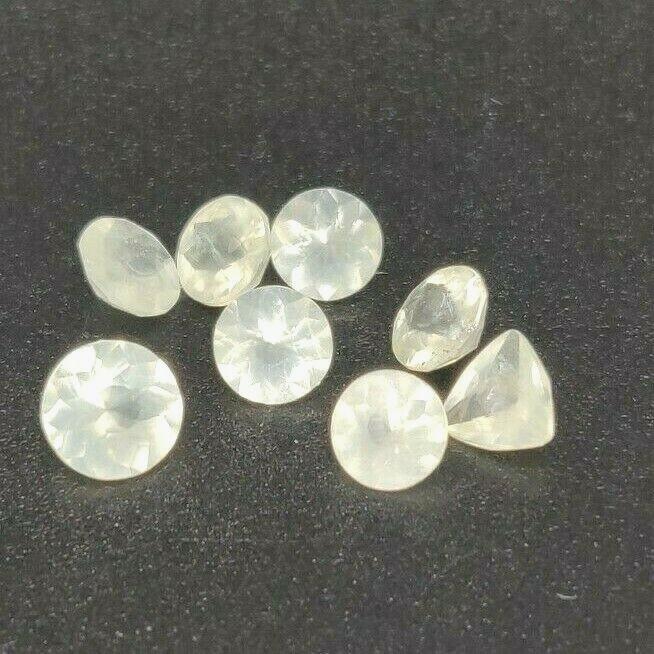
LOT 8 pc 3.65 ct PREHNITE – MALI
EXPERT VERIFIED
- Expert Verified Gemstone
- Fast Handling & Shipping
- Secure Vault Packaging
$ 100 Original price was: $ 100.$ 60Current price is: $ 60.
Offer amount Feild


Smart Collector Choice


Pay with Crypto & Get 10% Automatic Discount

Availability: 1 in stock
- Freakingcats Gemstone Database
Prehnite from Mali
Prehnite from Mali represents a spectacular and world-renowned occurrence of this calcium aluminum silicate. While Prehnite is found globally, the specimens from the Kayes Region of Mali are iconic for their unique “goblet” or “ball” formations and their incredible translucency. I have always been captivated by its “grape-jelly” or “mint-green” aesthetic; in Mali, it often forms as perfect, rounded botryoidal spheres that are frequently associated with dark, sharp crystals of Epidote. It possesses a vitreous to pearly luster and a “luminous” quality that seems to glow from within when light passes through its crystalline structure. For the collector, Malian Prehnite is a prize of both color and geometry—it is the definitive “modern classic” of the mineral world, representing a perfect synergy between a soft, pastel silicate and a rugged, dark matrix.
The Heritage & Discovery
Historical Significance: Prehnite holds the distinction of being the first mineral ever named after a person (Colonel Hendrik von Prehn in 1788). Historically, it was a rare curiosity until the discovery of the massive deposits in Mali in the late 1990s and early 2000s. In the world of fine minerals, Malian Prehnite revolutionized the market, providing the first abundant supply of gem-quality, translucent “spheres” that could be both displayed as specimens and faceted into high-end jewelry. It stands as a symbol of discovery and abundance, bridging the gap between historical European mineralogy and the vibrant, modern mining frontier of West Africa.
Discovery: The Malian deposits were brought to international attention in the late 20th century. Scientifically, it is a phyllosilicate. Its discovery in the Bendoukou and Sandare areas provided mineralogists with the first clear look at large-scale, “gemmy” Prehnite associated with high-quality Epidote. These specimens were unlike anything seen before—boasting a size and clarity that far surpassed the classic finds from Scotland or the United States. Since its identification, “Mali Prehnite” has become a trade name synonymous with the highest quality of the species.
Important Mines: The undisputed source for world-class Malian Prehnite is the Kayes Region, specifically the sites around Bendoukou and Sandare. I also have a high regard for the specimens found in the Arrondissement de Diakon. For the vault, I prioritize the “Epidote-associated” pieces, where the deep green, almost black needles of Epidote pierce through the mint-green Prehnite spheres, creating a high-contrast “flower” effect that is highly coveted by specialist collectors.
Mineralogical Profile
Description: Prehnite is a calcium aluminum silicate hydroxide that crystallizes in the orthorhombic system. It sits at a 6 to 6.5 on the Mohs scale, making it a durable stone that takes a magnificent, “greasy” to vitreous polish. It is characterized by its range of pale green, apple-green, and occasionally yellow-green colors.
One of its most identifying traits is its habit—it almost never forms distinct individual crystals, instead appearing as “globular” or “botryoidal” masses that look like clusters of grapes. It has a moderate refractive index ($n \approx 1.61$ to $1.67$) and a characteristic translucency that gives it a “dreamy,” diffused appearance. Because it is a phyllosilicate (a sheet silicate), it has a “toughness” that belies its delicate color. When I select a piece for the collection, I look for “even” color saturation and a “water-clear” translucency, as these highlight the sophisticated, three-dimensional geometry that makes Malian Prehnite a standout for the systematic collector. It is a light, high-vibration mineral that offers a unique, “organic” beauty unlike any other silicate species.
Chemical Formula: Ca2Al2Si3O10(OH)2
Related products
- Sale!Suggest a Price
![1.40 ct ANDALUSITE - BRAZIL]()
- Sale!Suggest a Price
![4.05 ct ANHYDRITE - MEXICO]()
- Sale!Suggest a Price
![1.05 ct ANHYDRITE - MEXICO]()
- Sale!Suggest a Price
![12.90 ct AMAZONITE - USA]()


