
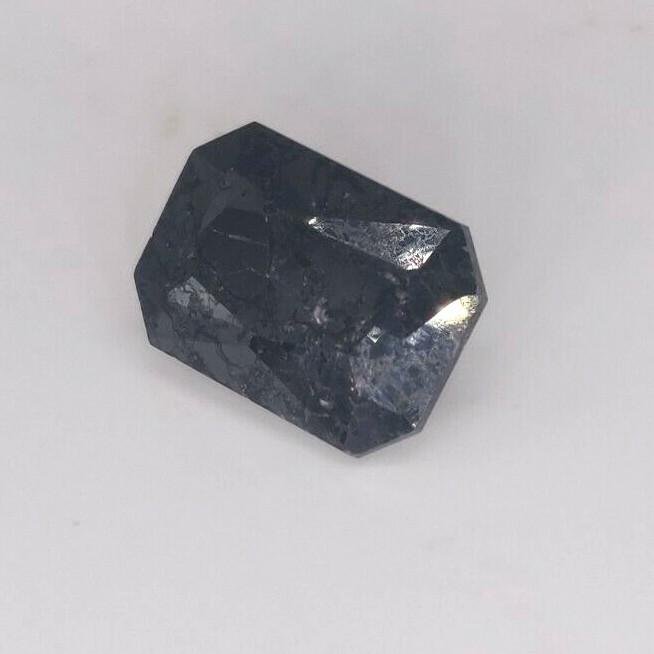
9.60 ct CHROMITE – USA
EXPERT VERIFIED
- Expert Verified Gemstone
- Fast Handling & Shipping
- Secure Vault Packaging
$ 300
Offer amount Feild


Smart Collector Choice


Pay with Crypto & Get 10% Automatic Discount

Availability: 1 in stock
- Freakingcats Gemstone Database
Chromite
Chromite is a gemstone of profound industrial importance and understated mineralogical power. An iron chromium oxide and a member of the spinel group, it is the world’s primary source of chromium—the element that gives Rubies their red and Emeralds their green. I have always been fascinated by its “heavy” presence; it typically occurs as iron-black to brownish-black masses or rare, sharp octahedral crystals. It possesses a sub-metallic to metallic luster that can appear almost like black glass when polished. For the collector, Chromite is a stone of the deep mantle, representing the high-pressure crystallization of ultramafic magmas. It is a dense, grounding mineral that provides a sleek, “stealth-wealth” aesthetic for the vault.
The Heritage & Discovery
Historical Significance: Chromite has been the backbone of the metallurgical industry since the 19th century. Historically, it was vital for the production of stainless steel and chrome plating, but its mineralogical value lies in its role as a “geological thermometer.” It typically forms in layered igneous intrusions and ophiolites, marking the earliest stages of magmatic cooling. In the world of fine minerals, it is celebrated for its rare, well-formed octahedrons, which are significantly harder to find than those of its cousin, Magnetite. It stands as a symbol of structural integrity and resistance, bridging the gap between raw industrial ore and the elite world of rare oxide crystals.
Discovery: The mineral was first described in 1797 based on specimens from the Ural Mountains, Russia. It was named for its high chromium content, which had been discovered by the chemist Louis Nicolas Vauquelin in the same year. Scientifically, it is an iron chromium oxide. Its discovery provided mineralogists with the first clear understanding of how chromium is concentrated in the Earth’s crust, leading to the identification of many other chromium-bearing species.
Important Mines: The legendary source for world-class, crystalline Chromite is the Bushveld Complex in South Africa, which contains the world’s largest reserves. I also have a high regard for the sharp, octahedral crystals found in the Ural Mountains of Russia and the Kempirsai Massif in Kazakhstan. For the vault, I prioritize the Russian specimens for their superior crystal definition and the South African material for its historic significance in the study of magmatic layering.
Mineralogical Profile
Description: Chromite is an iron chromium oxide that crystallizes in the isometric (cubic) system. It sits at a 5.5 on the Mohs scale, making it a durable mineral that takes a high-gloss, metallic polish. It is characterized by its sub-metallic to metallic luster and its deep black to dark brown color.
One of its most identifying traits is its brown streak, which distinguishes it from the black streak of Magnetite. It is also weakly magnetic, though nowhere near as strong as Magnetite. It has a high density ($4.5$ to $4.8$ g/cm³), giving it a substantial “heavy” feel in the hand. Because it is a member of the spinel group, it shares a similar structure with Gahnite and Galaxite. When I select a piece for the collection, I look for “sharp” octahedral edges and surfaces free of heavy pitting, as these highlight the sophisticated, “architectural” look that makes Chromite a standout for the systematic collector. It is a dense, grounding mineral that offers a unique, metallic depth unlike any other oxide species.
Chemical Formula: FeCr2O4


