
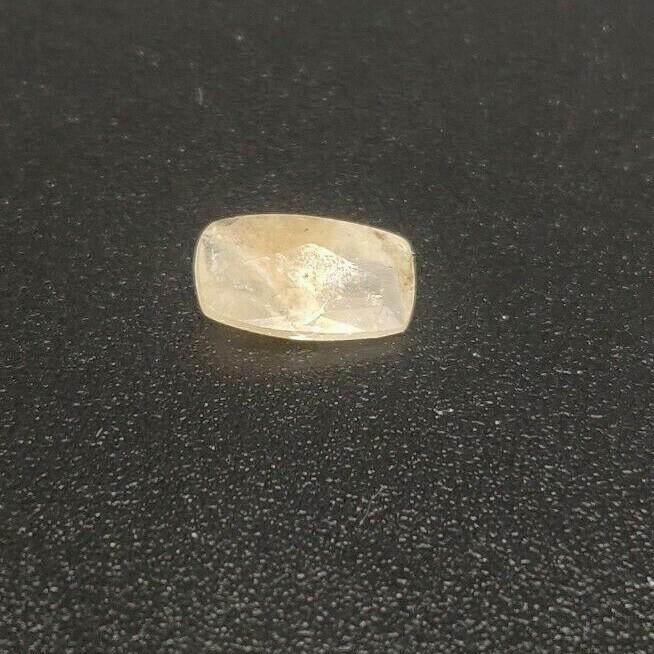
0.54 ct GLAUBERITE – USA
EXPERT VERIFIED
- Expert Verified Gemstone
- Fast Handling & Shipping
- Secure Vault Packaging
$ 100
Offer amount Feild


Smart Collector Choice


Pay with Crypto & Get 10% Automatic Discount

Out of stock
- Freakingcats Gemstone Database
Glauberite
For a long time, Glauberite was considered “uncuttable” for the gem world. My mastercutter and I spent many months obsessing over how to facet this material without destroying it. The problem is fundamental: Glauberite is a soluble sulfate. In standard gem cutting, water is used to cool the stone and the lap, but with Glauberite, water simply dissolves the gemstone. Freakingcat was among the first to ever successfully navigate this process, turning what was once just a salty mineral crust into a finished gemstone for high-end collectors.
The Heritage & Discovery
Historical Significance: Named in 1808, Glauberite has traditionally been a mineral of industrial interest rather than aesthetic value. Because it dissolves so easily, it rarely survives in a form that humans can appreciate outside of a controlled environment. In the world of rare stones, it represents the ultimate challenge—a material that demands a complete departure from traditional lapidary techniques.
Discovery: The mineral was first identified by Brongniart in the Salinas de Castilla, Spain. It was named after Johann Rudolf Glauber, the German-Dutch alchemist and chemist who discovered “Glauber’s Salt.” For over two centuries, it remained a specimen for the laboratory or the cabinet, never intended for the light of a display case.
Important Mines: While found globally in evaporite deposits, the most notable well-formed crystals often come from the Camp Verde Salt Mine in Arizona, USA, and various saline lakes in Spain and California. Finding crystals large and clear enough to survive the faceting process is an ongoing hunt.
Mineralogical Profile
Description: Glauberite is a monoclinic sodium calcium sulfate. It is typically transparent to translucent with a vitreous to pearly luster. It is relatively soft, sitting at a 2.5 to 3 on the Mohs scale, but its true difficulty lies in its solubility and its tendency to alter into gypsum or other minerals if exposed to humidity. When successfully cut, it has a delicate, ethereal beauty that belies its volatile nature.
Chemical Formula: Na2Ca(SO4)2


