
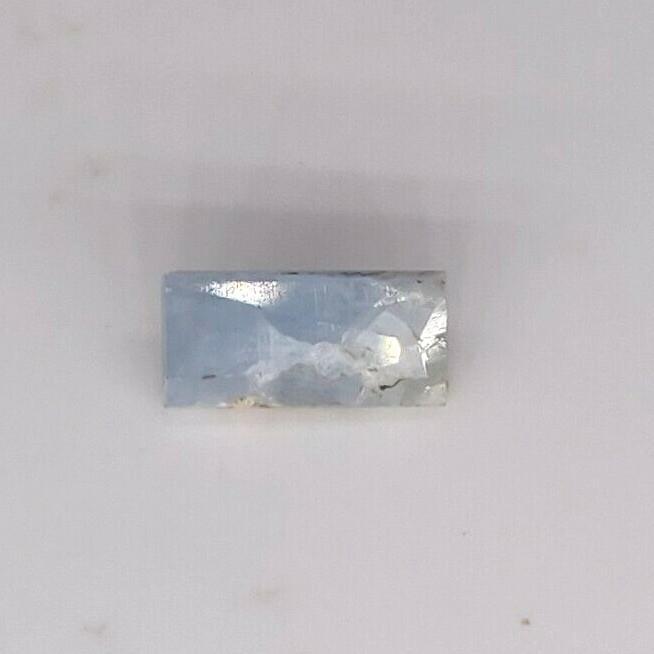
0.65 ct FOSHAGITE – USA
EXPERT VERIFIED
- Expert Verified Gemstone
- Fast Handling & Shipping
- Secure Vault Packaging
$ 120
Offer amount Feild


Smart Collector Choice


Pay with Crypto & Get 10% Automatic Discount

Out of stock
- Freakingcats Gemstone Database
Foshagite
Foshagite is a gemstone that exists at the subtle intersection of rarity and structural elegance. A calcium silicate hydroxide, it is a member of the Wollastonite group that I have always admired for its “fibrous” and “satiny” soul. Unlike the more famous, colorful silicates, Foshagite is a stone of understated purity, typically presenting as snow-white to colorless acicular crystals or compact, fibrous masses. It is a mineral of the high-temperature contact metamorphic zones, often found where limestone has been transformed by the heat of intrusive magmas. For me, a specimen of Foshagite is a study in texture—its silky luster and needle-like structure make it look more like a fragment of ancient, petrified silk than a traditional rock. It is a stone for the specialist who values the complex “architecture” of the silicate family.
The Heritage & Discovery
Historical Significance: Foshagite is a vital mineral for understanding the hydration and silica-enrichment of calcium-rich rocks. Historically, it was a significant discovery because it provided a clear link between the anhydrous silicates (like Wollastonite) and the more complex hydrated species. In the world of fine minerals, it is celebrated for its rare, “snowball-like” aggregates and its association with some of the world’s most complex skarn deposits. It stands as a symbol of the quiet, chemical precision required to stabilize hydroxide groups within a rigid silicate framework, representing a specific “thermal window” in the Earth’s crust.
Discovery: The mineral was first described in 1925 and was named in honor of William Frederick Foshag (1894–1956), a distinguished curator of minerals at the Smithsonian Institution and a legendary figure in Mexican mineralogy. Foshag was instrumental in documenting the eruption of the Parícutin volcano, and naming this rare, elegant species after him was a fitting tribute to his exhaustive work in the field. Since its formal identification, it has become a “must-have” for any serious systematic collector of the Wollastonite group.
Important Mines: The undisputed world capital for Foshagite is the Crestmore Quarry in Riverside County, California, USA. This site has produced the most well-defined and classic specimens ever found. I also have a high regard for the material coming from the Fuka Mine in Okayama Prefecture, Japan, and the Velardeña District in Durango, Mexico. For the vault, I prioritize the Crestmore material for its historical pedigree and the Japanese pieces for their occasional, spectacular “icy” translucency and sharp, fibrous definition.
Mineralogical Profile
Description: Foshagite is a calcium silicate hydroxide that crystallizes in the monoclinic system. It sits at a 5.5 on the Mohs scale, making it a relatively durable mineral, though its fibrous habit means it must be protected from “fraying” or splintering along its length. It is characterized by its vitreous to silky luster and its clean, white appearance.
One of its most identifying traits is its habit—it almost always forms as compact, parallel-fibrous masses or radiating sprays of needles. It has a moderate refractive index ($n \approx 1.59$ to $1.60$), which contributes to its soft, “inner” glow when light catches the silky fibers. Because it is a hydrated silicate, it is chemically stable but can be distinguished from the more common Wollastonite by its water content and slightly different optical properties. When I select a piece for the collection, I look for “pure white” specimens with a high silky sheen, as these represent the species in its most perfect and aesthetic form. It is a light, sophisticated mineral that offers a window into the delicate, high-heat chemistry of our planet’s metamorphic heart.
Chemical Formula: Ca4Si3O9(OH)2


