
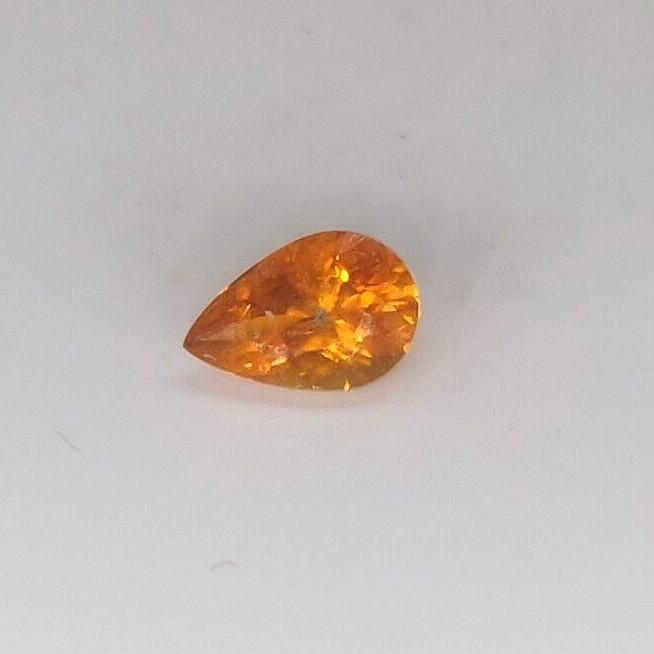
0.78 ct CLINOHUMITE – PAKISTAN
EXPERT VERIFIED
- Expert Verified Gemstone
- Fast Handling & Shipping
- Secure Vault Packaging
$ 200
Offer amount Feild


Smart Collector Choice


Pay with Crypto & Get 10% Automatic Discount

Availability: 1 in stock
- Freakingcats Gemstone Database
Clinohumite
Clinohumite is a gemstone that represents the vibrant, “fire-orange” soul of the Humite group. A magnesium silicate, it is a mineral I have always admired for its intense, honey-yellow to deep orange-red hues, which can rival the finest Spessartine Garnet or Padparadscha Sapphire. It typically forms as granular masses or sharp, monoclinic crystals within contact metamorphic zones, particularly where magnesium-rich rocks like marble have been altered. For the specialist, Clinohumite is a prize of extreme rarity; while the mineral is known to science, “gem-quality” crystals that are large and transparent enough for faceting are exceptionally elusive. It is a stone of warmth and structural complexity, offering a “glowing” aesthetic that feels as though it has captured the embers of a volcanic furnace.
The Heritage & Discovery
Historical Significance: Clinohumite is a vital species for understanding the behavior of fluorine and water in high-temperature metamorphic environments. Historically, it was a rare curiosity of the mineral world until the late 20th century, when spectacular gem-quality material began to emerge from the Pamir Mountains. In the world of fine minerals, it is celebrated for its incredible translucency and its association with rare species like Spinel and Phlogopite. It stands as a symbol of hidden potential, bridging the gap between common rock-forming silicates and the elite world of “investment-grade” collector gems. It serves as a reminder that the most humble-sounding “humite” minerals can produce masterpieces of color and light.
Discovery: The mineral was first described in 1876 and was named in reference to its monoclinic (inclined) symmetry and its relationship to the mineral Humite. The type-locality is Mount Vesuvius, Italy, where it was found as small, brilliant crystals in volcanic ejecta. Scientifically, it is a magnesium silicate with hydroxide and fluorine. Its discovery provided mineralogists with the first clear look at a “clinagonal” member of the humite series, helping to map the chemical and structural diversity of the deep crust. Since its formal identification, it has become one of the most sought-after “exotic” gemstones for the connoisseur’s vault.
Important Mines: The undisputed world capital for gem-quality Clinohumite is the Kukh-i-Lal deposit in the Pamir Mountains, Tajikistan. This legendary site has produced the largest and most vibrant orange crystals ever found. I also have a high regard for the spectacular material found in the Taymyr Peninsula in Russia and the classic, micro-crystals from Mount Somma, Italy. For the vault, I prioritize the Tajiki material for its unmatched “neon” orange color and its occasional, breathtaking transparency.
Mineralogical Profile
Description: Clinohumite is a magnesium silicate hydroxide/fluoride that crystallizes in the monoclinic system. It sits at a 6 on the Mohs scale, making it a relatively durable mineral, though it should be handled with care to preserve its high-gloss surfaces. It is characterized by its vitreous to resinous luster and its unmistakable range of golden-yellow to deep brownish-orange colors.
One of its most identifying traits is its high refractive index ($n \approx 1.63$ to $1.67$), which provides a “crisp” brilliance and a deep internal glow when light passes through the stone. It has a characteristic “birefringence,” meaning light is split into two rays as it travels through the crystal, which can create a subtle “doubling” of the facet edges. Because it is a magnesium-rich mineral, it is often found in association with Dolomite and Forsterite. When I select a piece for the collection, I look for a “saturated” orange color and a “water-clear” interior, as these represent the species in its most perfect and high-value form. It is a dense, high-vibration mineral that offers a unique, “solar” beauty unlike any other silicate species.
Chemical Formula: (Mg,Fe2+)9(SiO4)4(F,OH)2


