
- You cannot add another "6.55 ct YUGAWARALITE - INDIA" to your cart. View cart
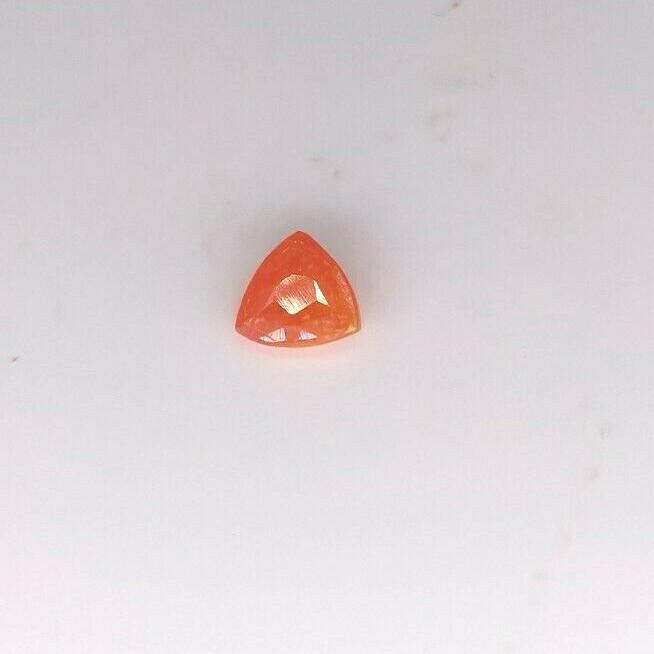
0.93 ct WULFENITE – USA
EXPERT VERIFIED
- Expert Verified Gemstone
- Fast Handling & Shipping
- Secure Vault Packaging
$ 200
Offer amount Feild


Smart Collector Choice


Pay with Crypto & Get 10% Automatic Discount

Out of stock
- Freakingcats Gemstone Database
Wulfenite
Wulfenite is a gemstone that defines the word “vibrant.” A lead molybdate, it is world-famous for its spectacular, paper-thin tabular crystals that look like glowing shards of orange or yellow glass. I have always been captivated by its “neon” personality; whether it is a honey-yellow from Mexico or a deep, “red-hot” orange from Arizona, the color saturation is almost unparalleled in the mineral kingdom. It is a secondary mineral found in the oxidation zones of lead deposits, and while it is soft and incredibly brittle, its high refractive index gives it a fire that rivals diamond. Cutting Wulfenite is a nerve-wracking feat of lapidary skill, but a finished stone is a masterpiece of light—a true “holy grail” for collectors of rare and colorful gems.
The Heritage & Discovery
Historical Significance: Wulfenite is one of the most sought-after collector minerals in history. Historically, it has been a significant ore of molybdenum, but its aesthetic value far outweighs its industrial use today. It represents a specific geochemical environment where lead-rich veins are exposed to molybdenum-bearing waters in an arid climate. In the world of fine minerals, it is celebrated for its diverse habits—from ultra-thin “window-pane” tablets to thick, blocky pyramids. It stands as a testament to the incredible geometric precision of nature, offering some of the most perfect and colorful crystal forms found anywhere on Earth.
Discovery: The mineral was first described in 1845 by Wilhelm Karl von Haidinger and was named in honor of Franz Xavier von Wulfen (1728–1805), an Austrian botanist and mineralogist. Wulfen had written a classic monograph on the “lead-spars” of Carinthia in 1785, and naming this brilliant species after him was a fitting tribute to his early contributions to European mineralogy. Since its naming, it has become the definitive molybdenum mineral for collectors worldwide.
Important Mines: While found in many localities, the most legendary source for deep orange crystals is the Red Cloud Mine in Arizona, USA. I also have a high regard for the spectacular yellow and orange specimens from the Los Lamentos District in Chihuahua, Mexico, and the “butterscotch” crystals from the Mežica Mine in Slovenia. For the vault, I prioritize the Red Cloud material for its world-class color and the Los Lamentos pieces for their incredible, blocky crystal thickness which makes them suitable for the most ambitious faceting projects.
Mineralogical Profile
Description: Wulfenite is a lead molybdate that crystallizes in the tetragonal system. It sits at a 2.5 to 3 on the Mohs scale, making it an exceptionally soft and fragile mineral that must be handled with the utmost care. It is characterized by its adamantine to resinous luster and its brilliant range of orange, yellow, and red colors.
One of its most identifying traits is its high density ($6.5$ to $7.0$ g/cm³) and its exceptional refractive index ($n \approx 2.40$), which gives it a brilliance and “dispersion” (fire) that is second only to a few stones like diamond or sphalerite. It typically forms as thin, square, tabular crystals, though it can also occur in bipyramidal or massive forms. Because of its lead content, it is heavy in the hand. When I facet Wulfenite, I have to be incredibly gentle; the material is so brittle that even a slight temperature change or a bit too much pressure can cause the stone to “craze” or shatter. However, when successful, the result is a gem with an “electric” glow that seems to generate its own light. It is a magnificent, light-sensitive treasure that remains a peak achievement for any lapidary.
Chemical Formula: Pb(MoO4)


