
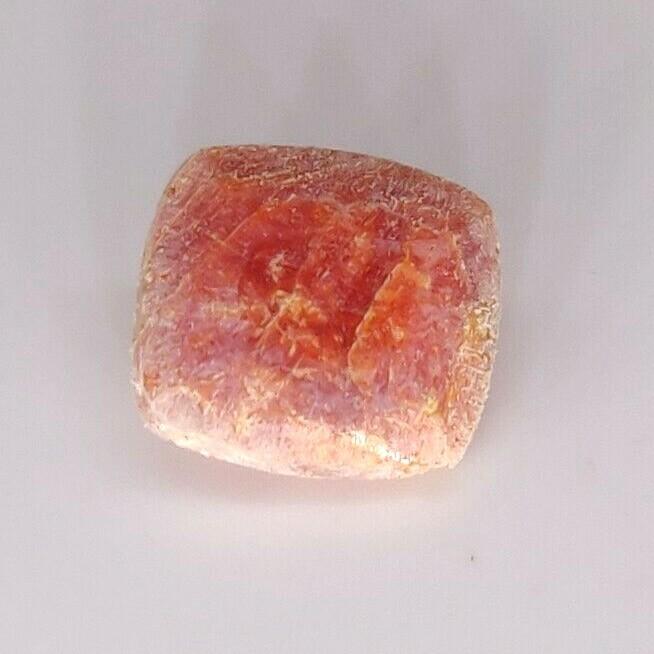
1.19 ct ROMERITE – USA
EXPERT VERIFIED
- Expert Verified Gemstone
- Fast Handling & Shipping
- Secure Vault Packaging
$ 200
Offer amount Feild


Smart Collector Choice


Pay with Crypto & Get 10% Automatic Discount

Out of stock
- Freakingcats Gemstone Database
Römerite
Römerite is a gemstone that captures the moody, industrial beauty of the iron-sulfate group. I have always been fascinated by its deep, “bruised” colors—ranging from a dark, cinnamon brown to a somber, rust-red or even a blackened violet. It is a secondary mineral that forms through the oxidation of pyrite in arid environments, appearing like dark, glassy embers nestled within the earth. While it is quite soft and sensitive to the environment, its vitreous luster and distinct triclinic crystal forms give it a sophisticated, geometric presence. It is a stone for the “intellectual” collector, one who appreciates the complex, water-heavy chemistry of the Earth’s metal-rich crust and the ephemeral beauty of minerals that exist in a delicate balance with the atmosphere.
The Heritage & Discovery
Historical Significance: Römerite is a vital species for mineralogists studying the “gossan” zones—the oxidized caps of sulfide ore deposits. Historically, it has been a significant indicator of high-acidity environments, as it typically forms from the breakdown of pyrite in the absence of much water. It represents a specific geochemical “snapshot” of iron and sulfur in a hydrated state. In the world of rare gems, it is prized for its unusual, dark coloration and its rarity in well-defined crystals. It stands as a testament to the transformative power of oxygen and time, turning common “fool’s gold” into a complex, crystalline silicate of deep, earthy tones.
Discovery: The mineral was first described in 1858 and was named in honor of Friedrich Adolph Römer (1794–1865), a prominent German geologist and superintendent of mines in the Harz Mountains. Römer was a pioneer in the stratigraphy of Northern Germany, and naming this dark, complex iron sulfate after him was a fitting tribute to his life’s work in the rugged mining districts of his homeland.
Important Mines: The most legendary and historic specimens come from the Rammelsberg Mine in the Harz Mountains of Germany. I also have a high regard for the spectacular, sharp crystals found in the Alcaparrosa Mine in the Atacama Desert of Chile and the Island Mountain Mine in California, USA. For the vault, I prioritize the Chilean material, as the arid desert conditions there allow for the preservation of the most well-defined and “glassy” crystals ever recorded for the species.
Mineralogical Profile
Description: Römerite is an iron sulfate mineral that crystallizes in the triclinic system. It sits at a 3 to 3.5 on the Mohs scale, making it a soft and delicate mineral that must be handled with great care. It is characterized by its vitreous luster and its typically dark brown to reddish-brown appearance.
One of its most identifying traits is its hygroscopic nature—it is a hydrated mineral that can be sensitive to changes in humidity. In very dry air, it may lose water and turn to a powdery crust, while in very humid air, it can actually begin to dissolve. It typically forms as small, tabular crystals or as granular masses. It has a moderate refractive index ($n \approx 1.52$ to $1.58$), giving it a soft, “glow-from-within” appearance when light catches the edges of a dark crystal. Because it contains both $Fe^{2+}$ and $Fe^{3+}$ ions, its chemistry is a fascinating study in iron oxidation. When I select a piece, I look for “fresh” crystals with a high, glassy sheen, as these represent the mineral in its most stable and beautiful form.
Chemical Formula: Fe2+Fe3+2(SO4)4·14H2O


