
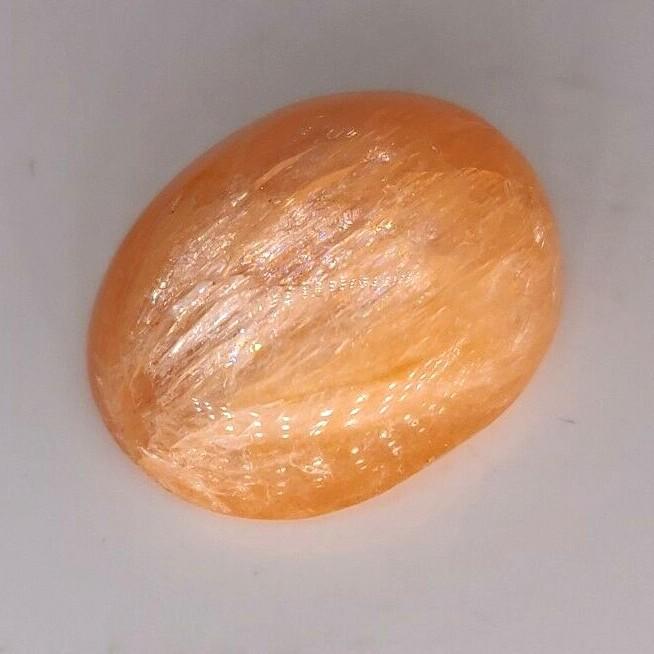
8.90 ct STELLERITE – INDIA
EXPERT VERIFIED
- Expert Verified Gemstone
- Fast Handling & Shipping
- Secure Vault Packaging
$ 100
Offer amount Feild


Smart Collector Choice


Pay with Crypto & Get 10% Automatic Discount

Availability: 1 in stock
Gemstone Details
Gem Variety:
Orange Stellerite
Origin:
India
Carat Weight:
8.90
Length (mm):
16.4
Width (mm):
13.7
Depth (mm):
6.5
Shape:
Cabochon
Color
Orange
Treatment:
No Treatment
Certificate:
On Request
- Freakingcats Gemstone Database
Stellerite Stellerite is a gemstone that represents the "sophisticated" peak of the calcium-rich zeolites. A hydrated calcium aluminum silicate, it is a mineral I have always admired for its incredible, "radiating" geometry and its pearly, silk-like luster. It is often mistaken for its close relative, Stilbite, but for the specialist, Stellerite is distinguished by its higher symmetry and its tendency to form spectacular, "ball-like" or "fan-shaped" clusters of crystals. It typically presents as colorless to "honey-orange" or a soft, creamy white. It is a stone of the volcanic cavities, representing the final, delicate crystallization from cooling hydrothermal fluids. It is a mineral of "elegant expansion," offering a soft, high-frequency aesthetic that makes it a true prize for the systematic vault. The Heritage & Discovery Historical Significance: Stellerite is a vital species for understanding the structural diversity within the zeolite group. Historically, it was often overlooked as a variety of Stilbite until advanced crystallographic studies proved it to possess orthorhombic symmetry. In the world of fine minerals, it is celebrated for its ability to form large, aesthetic "spherical" aggregates that appear like frozen fireworks. It stands as a symbol of structural integrity and discovery, bridging the gap between common volcanic silicates and the elite world of rare, high-symmetry collector gems. It serves as a reminder that even closely related minerals can hold unique secrets that are only revealed to the most patient observer. Discovery: The mineral was first described in 1909 and was named in honor of Georg Wilhelm Steller (1709–1746), a German physician and pioneering explorer of Alaska and the North Pacific. The type-locality is Commander Islands, Russia. Naming this "northern" and "pure" mineral after such a dedicated naturalist was a fitting tribute to his spirit of exploration. Since its formal identification, it has become a staple for those who value the "architectural" complexity of the zeolite family. Important Mines: The undisputed world capital for the finest, most vibrant Stellerite is the Sarbay Mine in Rudny, Kazakhstan. This site produces the legendary "electric orange" spheres that are the benchmark for the species. I also have a high regard for the spectacular, colorless to white crystals found in the Garrawilla area of New South Wales, Australia, and the "gemmy" clusters from Poona, India. For the vault, I prioritize the Kazakh material for its unmatched color saturation and the Australian specimens for their exceptional crystal size and transparency. Mineralogical Profile Description: Stellerite is a hydrated calcium aluminum silicate that crystallizes in the orthorhombic system. It sits at a 4.5 on the Mohs scale, making it a relatively soft mineral that requires careful handling. It is characterized by its vitreous luster on the faces and a distinct, shimmering pearly luster on the cleavage planes. One of its most identifying traits is its radiating habit—it often forms "bow-tie" or "globe" shapes composed of many individual crystals. It has a low refractive index ($n \approx 1.48$ to $1.49$), which gives it an "icy" or "misty" appearance when colorless. Because it is a calcium-pure zeolite (lacking the sodium often found in Stilbite), it maintains a more rigorous orthorhombic symmetry. When I select a piece for the collection, I look for "perfect" spherical symmetry and a high-gloss pearly sheen, as these represent the species in its most aesthetic and energetically pure form. It is a light, high-vibration mineral that offers a unique, "organic" beauty unlike any other silicate. Chemical Formula: CaAl2Si7O18·7H2O


