
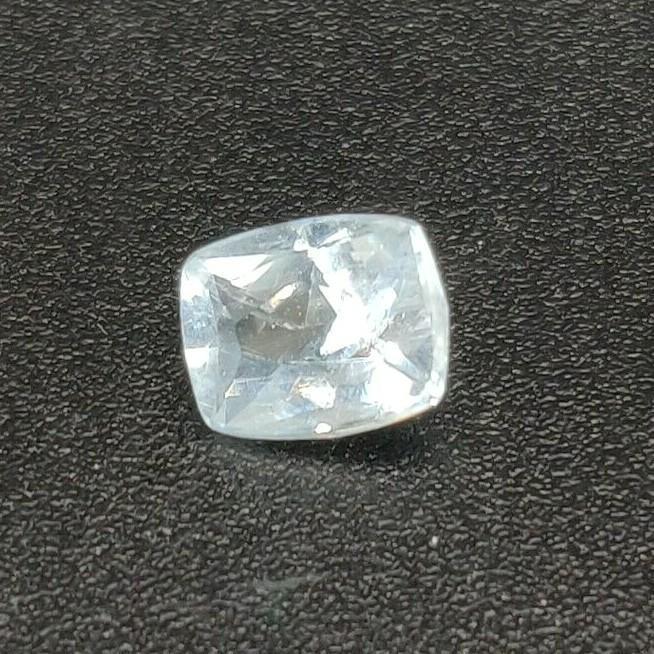
1.05 ct BLUE BARITE – MOROCCO
EXPERT VERIFIED
- Expert Verified Gemstone
- Fast Handling & Shipping
- Secure Vault Packaging
$ 100
Offer amount Feild


Smart Collector Choice


Pay with Crypto & Get 10% Automatic Discount

Out of stock
- Freakingcats Gemstone Database
Barite represents the "heavy anchor" of the sulfate world. A barium sulfate, it is a mineral I have always respected for its "shocking" density—a physical trait so pronounced that it often surprises the uninitiated when they first lift a specimen. It typically presents as beautiful, "blade-like" crystals, "desert roses," or as clear, gemmy prisms that range from a delicate "honey-yellow" and "sky-blue" to a pure, "ghostly" white. For the specialist, Barite is a prize of geometrical precision; its orthorhombic crystals often form complex, "book-like" clusters with a vitreous to pearly luster. It is a stone of "grounded clarity," providing a sophisticated, substantial aesthetic that makes it an essential structural pillar for the systematic vault.
The Heritage & DiscoveryHistorical Significance: Barite has been a vital mineral throughout history, serving as the primary source of barium for everything from drilling fluids to medical imaging. In the world of fine minerals, it is celebrated for its "Bologna Stone" history—a 17th-century discovery in Italy where barite nodules were found to phosphoresce after being heated, captivating the early scientific world. It stands as a symbol of hidden potential and stability, bridging the gap between heavy industrial minerals and the elite world of "water-clear" collector gems. It serves as a reminder that even the most "utilitarian" minerals can achieve a level of architectural perfection that rivals the most famous silicates.
Discovery: The name is derived from the Greek barys, meaning "heavy," in reference to its high specific gravity. It was formally described in its modern sense in the early 19th century. Scientifically, it is the barium endmember of the barite group. Its discovery in hydrothermal veins provided mineralogists with the first clear look at how heavy metals can be transported and deposited by warm, mineral-rich fluids. My own respect for this material grew from observing its extraordinary "phantom" inclusions and its ability to form sharp, "razor-edged" blades that seem almost too precise to be natural. Since its identification, it has become a "must-have" for collectors who value the "physics of weight" and textbook crystal morphology.
Important Mines: The undisputed world capital for the finest "golden" gem-grade Barite is the Meikle Mine in Nevada, USA. I also have a high regard for the spectacular "electric blue" blades from Sidi Lahcen, Morocco, and the historic, "honey-colored" crystals from Cumbria, England. For the vault, I prioritize the Nevada material for its unmatched transparency and the Moroccan pieces for their vibrant, "saturated" blue hues and architectural clusters.
Mineralogical ProfileDescription: Barite is a barium sulfate that crystallizes in the orthorhombic system. It sits at a 3 to 3.5 on the Mohs scale, making it a soft and delicate mineral that must be handled with care to avoid bruising its perfect cleavage. It is characterized by its vitreous to pearly luster and its unmistakable "heavenly" range of colors.
One of its most identifying traits is its extreme specific gravity ($SG \approx 4.5$), which makes it feel significantly heavier than common minerals like Quartz or Calcite. It has a moderate refractive index ($n \approx 1.63$ to $1.64$) and exhibits a characteristic perfect cleavage in three directions. Because it is a hydrothermal mineral, it is often found in association with Fluorite, Calcite, and various sulfide ores like Galena. When I select a piece for the collection, I look for "razor-sharp" terminations and a lack of surface "dings," as these highlight the sophisticated, three-dimensional geometry that makes Barite a standout for the systematic specialist. It is a dense, high-vibration mineral that offers a unique, "architectural" beauty unlike any other sulfate.
Chemical Formula: BaSO4


