
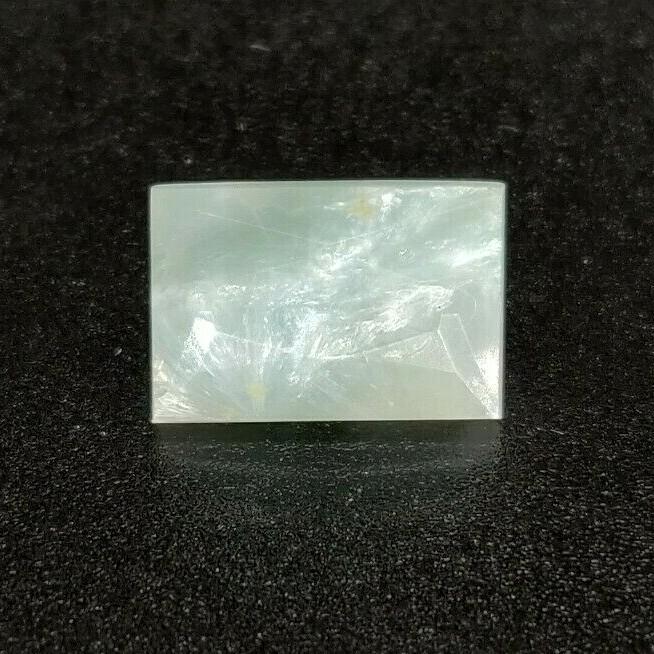
5.15 ct BRUCITE – RUSSIA
EXPERT VERIFIED
- Expert Verified Gemstone
- Fast Handling & Shipping
- Secure Vault Packaging
$ 120
Offer amount Feild


Smart Collector Choice


Pay with Crypto & Get 10% Automatic Discount

Availability: 1 in stock
- Freakingcats Gemstone Database
Brucite
Brucite is a gemstone that often surprises collectors with its deceptive simplicity. A magnesium hydroxide, it is a mineral that I have always admired for its “clean” and “icy” character. While it is commonly found as a humble white or grey component of marble, the rare, gem-quality specimens are a different story entirely. I am particularly drawn to the vibrant, “electric” lemon-yellow crystals from Pakistan and the rare, translucent blue or sea-green varieties. It possesses a pearly luster on its cleavage faces that gives it a soft, ethereal glow. It is a stone of purity and structural grace, representing the quiet crystallization of magnesium-rich fluids in metamorphic environments. For the specialist, a clean Brucite crystal is a study in delicate luster and unusual chemistry.
The Heritage & Discovery
Historical Significance: Brucite is a vital mineral for understanding the hydration of magnesium-rich rocks. Historically, it has been a significant source of magnesia for industrial applications, but its value in the gem world is purely aesthetic. It represents a specific geochemical “snapshot” where magnesium is stabilized in a hydroxide form rather than a carbonate or silicate. In the world of fine minerals, it is celebrated for its spectacular “foliated” or “tabular” crystals, standing as a favorite for those who appreciate the subtle, pearly textures of the hydroxide family. It serves as a reminder that even the simplest chemical formulas can produce breathtaking geometric beauty.
Discovery: The mineral was first described in 1824 and was named in honor of Archibald Bruce (1777–1818), a pioneering American mineralogist and the editor of the first American scientific journal devoted to mineralogy. Bruce discovered the mineral at Castle Point, Hoboken, New Jersey. Naming this magnesium-rich species after him was a fitting tribute to his role in establishing mineralogy as a formal science in the United States. Since then, it has become the definitive magnesium hydroxide for collectors worldwide.
Important Mines: While found globally in serpentine deposits, the most legendary source for vibrant, gem-grade crystals is the Killa Saifullah District in Balochistan, Pakistan. These mines produce the world-famous “neon” yellow specimens. I also have a high regard for the classic white and blue-grey plates from the Wood’s Chrome Mine in Pennsylvania, USA, and the large, translucent crystals from the Kullorsuaq area in Greenland. For the vault, I prioritize the Pakistani yellow material for its unmatched color saturation and the Russian specimens from Bazhenovskoe for their incredible crystal size and pearly luster.
Mineralogical Profile
Description: Brucite is a magnesium hydroxide that crystallizes in the trigonal system. It sits at a 2.5 to 3 on the Mohs scale, making it a very soft and delicate mineral that must be handled with extreme care to avoid scratching or “bruising” the crystal faces. It is characterized by its vitreous to pearly luster and its wide range of colors, including yellow, blue, green, and white.
One of its most identifying traits is its perfect basal cleavage. Much like mica, Brucite can be split into thin, flexible (but not elastic) flakes. It has a moderate refractive index ($n \approx 1.56$ to $1.58$), which provides a soft, “watery” brilliance when light catches the interior. Because it is a hydroxide, it is chemically sensitive and can be etched by acids. When I select a piece for the collection, I look for “fresh” crystals with sharp, un-damaged edges and high-reflectivity on the pearly faces, as these highlight the unique, layered soul of the mineral. It is a dense, high-vibration mineral that remains a standout for its “neon” personality and historic American roots.
Chemical Formula: Mg(OH)2


