

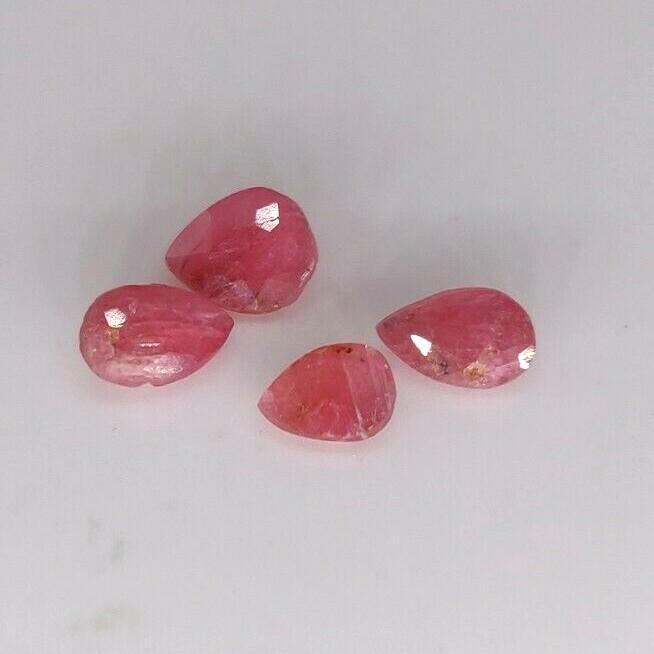
1.30 ct COBALTO CALCITE – MOROCCO
EXPERT VERIFIED
- Expert Verified Gemstone
- Fast Handling & Shipping
- Secure Vault Packaging
$ 200 Original price was: $ 200.$ 120Current price is: $ 120.
Offer amount Feild


Smart Collector Choice


Pay with Crypto & Get 10% Automatic Discount

Availability: 1 in stock
- Freakingcats Gemstone Database
Cobaltoan Calcite represents the "sweetheart" of the carbonate world. Often referred to as "Bubble Gum Pink" Calcite, it is a mineral I have always respected for its unapologetic, neon-magenta intensity—a color profile that feels almost too vibrant to be natural. It typically presents as lustrous, druzy crusts or as "plump," rhombohedral crystals with a vitreous to pearly luster. For the specialist, Cobaltoan Calcite is a prize of chromatic substitution; it is a standard calcium carbonate where trace amounts of cobalt have replaced calcium, resulting in a "shocking" pink that remains one of the most coveted hues in the systematic vault.
The Heritage & DiscoveryHistorical Significance: Cobaltoan Calcite is a vital species for understanding the secondary enrichment of cobalt-bearing ore deposits. Historically, it was often found in the deep, dark copper and cobalt mines of Central Africa and Europe, serving as a bright "beacon" for miners. In the world of fine minerals, it is celebrated for its extraordinary "glow" and its ability to form thick, "carpet-like" druzes. It stands as a symbol of emotional resilience and "radiant" beauty, bridging the gap between heavy industrial ores and the elite world of "neon" collector carbonates. It serves as a reminder that even in the most rugged mining environments, nature can produce a color as delicate and joyful as a spring blossom.
Discovery: The variety was formally recognized as cobalt-bearing Calcite as mineralogists began to map the influences of transition metals on the carbonate lattice. Scientifically, it is a variety of Calcite ($CaCO_3$). Its discovery in the Bou Azzer district and the Katanga Copper Crescent provided mineralogists with the first clear look at how cobalt ($Co^{2+}$) creates a distinct, light-absorbing profile that results in its signature pink. My own respect for this material grew from observing its fluorescence; under UV light, some specimens exhibit a "ghostly" pinkish-red glow that adds another layer of sophistication to the piece.
Important Mines: The undisputed world capital for the finest "Bubble Gum Pink" Cobaltoan Calcite is the Bou Azzer District in Morocco, specifically the Agoudal Mine. These specimens are legendary for their high-gloss luster and deep magenta saturation. I also have a high regard for the spectacular, "velvety" pink druzes from the Mashamba West Mine in the Lualaba Province, Democratic Republic of the Congo. For the vault, I prioritize the Moroccan material for its sharp crystal definition and the Congolese pieces for their sheer, "uninterrupted" blankets of pink.
Mineralogical ProfileDescription: Cobaltoan Calcite is a calcium carbonate that crystallizes in the trigonal system. It sits at a 3 on the Mohs scale, making it a soft and delicate mineral that must be protected from acids and sharp impacts. It is characterized by its vitreous luster and its unmistakable "magenta-to-flesh" pink color palette.
One of its most identifying traits is its perfect rhombohedral cleavage ({1011}) and its specific gravity ($SG \approx 2.7$ to 2.8), which makes it feel relatively light in the hand. It has a moderate refractive index ($n \approx 1.48$ to 1.65) and exhibits a characteristic strong birefringence (double refraction), though this is often masked in the druzy varieties. Because it forms in the oxidation zones of cobalt-rich deposits, it is often found in association with Malachite, Kolwezite, and Dolomite. When I select a piece for the collection, I look for "even" color saturation and a "sparkling" luster, as these highlight the sophisticated, three-dimensional geometry of the mineral's growth. It is a light, high-vibration mineral that offers a unique, "vivid-calm" beauty unlike any other carbonate species.
Chemical Formula: (Ca,Co)CO3
Related products
- Sale!Suggest a Price
![1.48 ct ANDALUSITE - BRAZIL]()
- Sale!Suggest a Price
![12.75 ct AMAZONITE - USA]()
- Sale!Suggest a Price
![3.90 ct AERINITE - SPAIN]()
- Sale!Suggest a Price
![6.80 ct 2 pc AERINITE - SPAIN]()


