
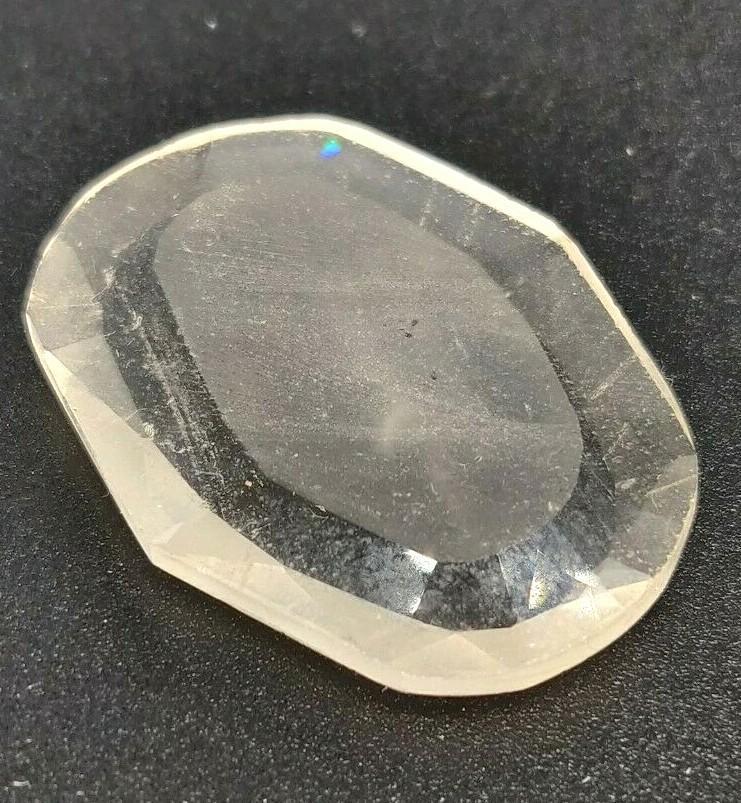
41.60 ct BEACH GLASS – OCEAN
EXPERT VERIFIED
- Expert Verified Gemstone
- Fast Handling & Shipping
- Secure Vault Packaging
$ 70
Offer amount Feild


Smart Collector Choice


Pay with Crypto & Get 10% Automatic Discount

Out of stock
- Freakingcats Gemstone Database
Beach Glass represents the "ocean’s alchemy," a collaboration between human industry and the relentless power of the tides. While some may wonder why a collection dedicated to rare minerals includes "common" broken glass, the answer lies in the extraordinary transformation that occurs over decades of submersion. These are not merely shards; they are artifacts of a bygone era—fragments of vintage bottles, apothecary jars, and tableware—that have been battered, tumbled, and chemically etched by saltwater until they achieve a soft, frosted "glow." For the specialist, Beach Glass is a prize of historical serendipity. Even when we facet the outlines to provide a structured gem-like silhouette, the frosted surface remains a testament to the stone's journey through the surf. It is a "gem" of endurance, providing a sophisticated, weathered aesthetic that celebrates the beauty found in reclaimed history.
The Heritage & DiscoveryHistorical Significance: Beach Glass (often called "Sea Glass") carries a narrative of human consumption and coastal life. Historically, the rarest colors—such as "Cobalt Blue," "Ruby Red," and the legendary "Uranium Green"—come from specific manufacturing periods, such as the Victorian era or the Great Depression. In the world of collectibles, it is celebrated for its natural hydration; the "pitting" on the surface is a chemical reaction between the glass and the alkaline ocean water that takes 20 to 50 years to develop. It stands as a symbol of resilience and the "softening" of sharp edges, bridging the gap between urban waste and the elite world of "found" treasures. It serves as a reminder that with enough time and the right environment, even a broken fragment can become a source of appreciation for collectors worldwide.
Discovery: Unlike minerals found in mines, Beach Glass is discovered through "beachcombing" along coastlines, particularly near old ports, shipwrecks, or former coastal dumping sites. Scientifically, it is an amorphous solid (silica glass) that has undergone mechanical weathering. Its "discovery" as a collectible began with enthusiasts who recognized that the ocean had effectively performed the job of a lapidary, tumbling the sharp glass into smooth, "sugar-frosted" gems. My own respect for including this in the collection is rooted in its historical variety; finding a piece of "Black Glass" (deep olive green glass from the 1700s) is as significant to a beach glass hunter as finding a rare crystal is to a miner.
Important Mines: While not "mines" in the traditional sense, the world’s most famous "deposits" for rare Beach Glass include Glass Beach in Fort Bragg, California, and the legendary shores of Seaham, England, known for its "Multis" (multi-colored glass scraps from Victorian glassworks). I also have a high regard for the "old-stock" finds from the Northeastern United States and the Isle of Skye. For the vault, I prioritize pieces with "c-marks" (tiny crescent-shaped pits), as these are the definitive signature of a genuine, ocean-tumbled heritage.
Mineralogical ProfileDescription: Beach Glass is an amorphous (non-crystalline) silicate material. Because it is man-made in origin but nature-finished, it typically sits at a 5.5 to 6.5 on the Mohs scale, depending on the lead and silica content of the original glass. It is characterized by its "frosted" or matte luster and its vast range of "found" colors.
One of its most identifying traits is its lack of cleavage; glass breaks with a "conchoidal" (shell-like) fracture, which the ocean then rounds into soft curves. It has a refractive index ($n \approx 1.50$ to 1.55) similar to Quartz, but its distinctive "frosted" skin acts as a natural light diffuser, giving the stone a soft, internal "glow." Because it is a surface-find, it is often found in association with shells, driftwood, and smooth river stones. When I select a piece for the collection, I look for "perfect frosting" and the rare "thick" fragments from vintage bottle bottoms, as these highlight the sophisticated, three-dimensional history of the piece. It is a light, high-vibration "gem" that offers a unique, nostalgic beauty unlike any other material in the vault.
Chemical Formula: SiO2(+Na2O, CaO, etc.)


