
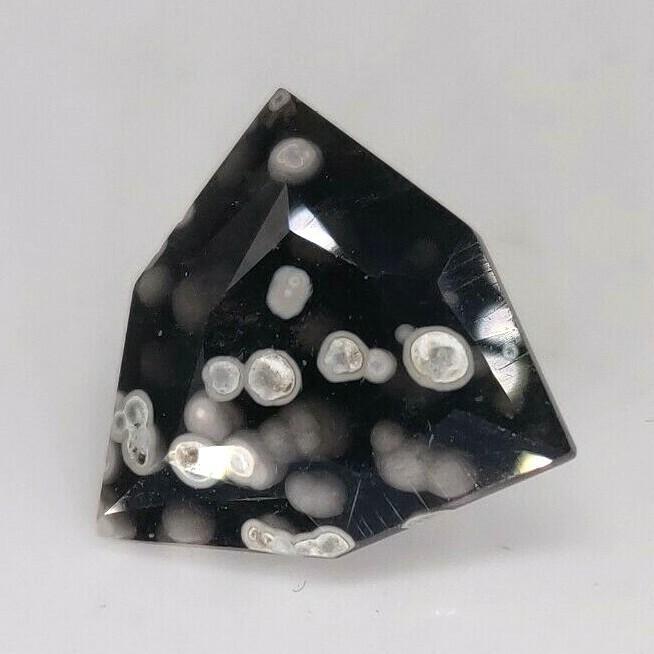
6.80 ct OBSIDIAN w. ULVOSPINEL – ITALY
EXPERT VERIFIED
- Expert Verified Gemstone
- Fast Handling & Shipping
- Secure Vault Packaging
$ 100
Offer amount Feild


Smart Collector Choice


Pay with Crypto & Get 10% Automatic Discount

Out of stock
- Freakingcats Gemstone Database
Obsidian with Ulvospinel
Obsidian with Ulvospinel is a gemstone that represents a truly “alien” aesthetic in the mineral world. While common Obsidian is a smooth, volcanic glass, this specific variety is characterized by its “strange” and captivating texture—it looks as though it is riddled with “cheeseholes.” This phenomenon occurs when tiny, metallic crystals of Ulvospinel (a titanium iron oxide) crystallize within the cooling silica melt. I have always found this stone to be a master of contrast; the dark, sleek glass of the Obsidian serves as a “void” that is interrupted by these spherical or irregular voids and metallic inclusions. For the collector, it is a prize of volcanic physics, offering a tactile and visual experience that feels more like a fragment of deep-space debris than a terrestrial stone.
The Heritage & Discovery
Historical Significance: Obsidian itself has been the “sharp edge” of human history for millennia, used for everything from sacrificial daggers to modern surgical scalpels. However, the inclusion-rich varieties like those containing Ulvospinel are a modern fascination for the high-end collector. Historically, “holey” stones were often considered talismans of protection. In the world of fine minerals, this combination represents the immiscibility of metallic oxides within a silicate glass. It stands as a symbol of the “unfinished” or “porous” nature of creation, bridging the gap between the solid earth and the fluid heat of the mantle. It serves as a reminder that even the most “perfect” glass can be made more beautiful by the “interruption” of metallic crystals.
Discovery: The presence of Ulvospinel in volcanic glass was a significant discovery for mineralogists studying the “Fe-Ti-O” (Iron-Titanium-Oxygen) systems. Its name is derived from its type-locality, the Ulvö Islands in Sweden. When found in Obsidian, it tells a story of rapid cooling where the titanium and iron did not have time to fully integrate into a crystal lattice, instead forming the “bubble-like” or “cheesehole” structures that define the gem’s appearance. My own attraction to this stone grew from its “industrial-organic” look—it is a gemstone that looks engineered by nature’s own hand.
Important Mines: The most iconic and sought-after specimens of this “cheesehole” Obsidian come from the volcanic fields of Armenia and the Caucasus Mountains. I also have a high regard for the unique material found in the Lipari Islands, Italy. For the vault, I prioritize the Armenian specimens for their exceptionally large and well-defined “pores” and the deep, ink-black quality of the surrounding glass, which makes the metallic Ulvospinel “shimmer” within the holes more pronounced.
Mineralogical Profile
Description: This gemstone is a combination of Amorphous Silica Glass (Obsidian) and Titanium Iron Oxide (Ulvospinel). It sits at a 5 to 6 on the Mohs scale, making it a durable stone, though the “holes” make it more fragile than solid glass. It is characterized by its vitreous luster on the glass surfaces and a sub-metallic luster within the inclusions.
One of its most identifying traits is its vesicular or porous texture. The “cheeseholes” are often lined with micro-crystals of Ulvospinel, which can give the interior of the holes a subtle, silvery-black “spark.” It has a moderate refractive index ($n \approx 1.48$ to $1.51$ for the glass) and is almost entirely opaque except on the thinnest edges. Because it is a volcanic product, it is often found in association with Pumice and Cristobalite. When I select a piece for the collection, I look for a “balanced” distribution of the holes and a high-gloss polish on the surrounding obsidian, as these highlight the “Swiss cheese” geometry that makes this stone a standout for the systematic specialist. It is a dense, grounding mineral that offers a unique, “architectural” depth unlike any other volcanic glass.
Chemical Formula: SiO2 (Obsidian) + TiFe2+2O4 (Ulvospinel)


