

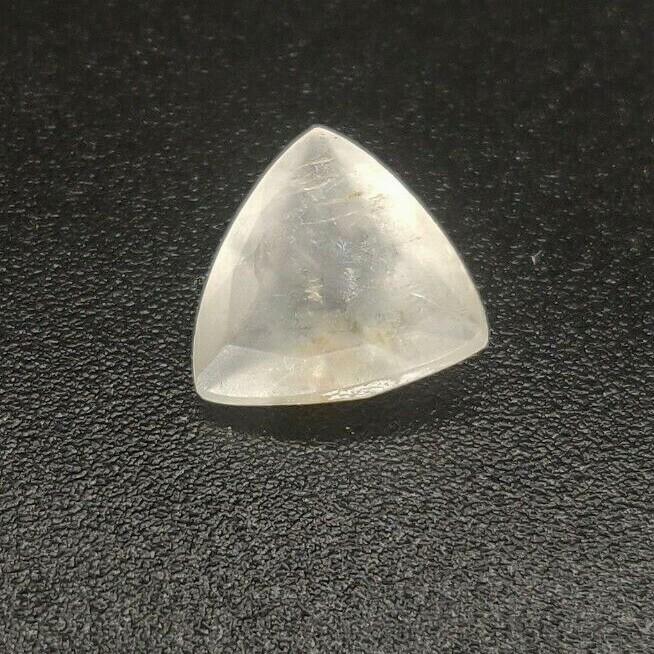
1.29 ct GAYLUSSITE – USA
EXPERT VERIFIED
- Expert Verified Gemstone
- Fast Handling & Shipping
- Secure Vault Packaging
$ 300 Original price was: $ 300.$ 180Current price is: $ 180.
Offer amount Feild


Smart Collector Choice


Pay with Crypto & Get 10% Automatic Discount

Availability: 1 in stock
- Freakingcats Gemstone Database
Gaylussite
Gaylussite was not named to celebrate Pride, but rather to honor a giant of scientific history. It is a mineral that often catches collectors off guard with its delicate, glassy transparency and its unique “double salt” chemistry. I’ve always found it to be a fascinating study in environmental stability; it forms in the evaporated remains of ancient alkaline lakes, essentially capturing a snapshot of a very specific, salt-rich moment in time. While it might look like a simple crystal, there is a technical elegance to its monoclinic structure that I deeply appreciate. It’s a stone for the collector who values the history of chemistry as much as the beauty of the specimen itself.
The Heritage & Discovery
Historical Significance: Gaylussite serves as a mineralogical tribute to the era of foundational chemistry. It is a hydrated sodium calcium carbonate that represents the complex precipitation processes found in soda lakes. Its existence tells us about the concentration of carbonates and the specific temperature conditions of the water from which it crystallized. It stands as a classic example of the 19th-century tradition of naming new geological discoveries to create a “living” map of scientific achievement.
Discovery: The mineral was first described in 1826. It was named after the famous French chemist and physicist Joseph Louis Gay-Lussac (1778–1850). Honoring Gay-Lussac was a nod to his monumental contributions to science, including his laws on the behavior of gases and his role in the discovery of the element boron. While Gay-Lussac didn’t discover the mineral himself, his influence on the chemical understanding of the 19th century made him a natural choice for such a dedication.
Important Mines: The type locality for this mineral is Lagunillas in Venezuela, where it was first identified in the saline deposits of a small lake. However, for collectors today, the most famous and well-formed crystals often come from the Searles Lake in San Bernardino County, California, or Lake Magadi in Kenya. These alkaline environments provide the perfect “nursery” for the sharp, wedge-shaped crystals that define the species.
Mineralogical Profile
Description: Gaylussite is a hydrated sodium calcium carbonate mineral that crystallizes in the monoclinic system. It is quite soft, sitting at a 2.5 on the Mohs scale, and is known for being brittle with a vitreous luster. It is typically colorless to white or yellowish. One critical note for any collector: because it is a hydrated mineral, it can be unstable in very dry environments, sometimes dehydrating into a chalky white powder if not kept in a stable, controlled climate. This fragility is part of what makes a well-preserved, clear crystal so desirable.
Chemical Formula: Na2Ca(CO3)2·5H2O
Related products
- Sale!Suggest a Price
![0.40 ct ANTHRACITE - USA]()
- Sale!Suggest a Price
![12.30 ct AMAZONITE - USA]()
- Sale!Suggest a Price
![0.42 ct ANATASE - AUSTRALIA]()
- Sale!Suggest a Price
![14.30 ct 2 pc AERINITE - SPAIN]()


