

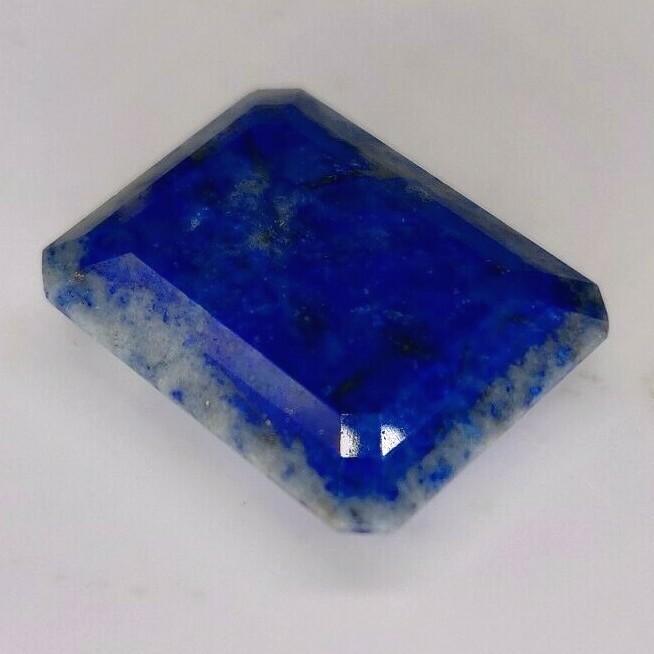
20.93 ct LAPIS LAZULI – PAKISTAN
EXPERT VERIFIED
- Expert Verified Gemstone
- Fast Handling & Shipping
- Secure Vault Packaging
$ 100 Original price was: $ 100.$ 60Current price is: $ 60.
Offer amount Feild


Smart Collector Choice


Pay with Crypto & Get 10% Automatic Discount

Availability: 1 in stock
- Freakingcats Gemstone Database
Lapis Lazuli
Lapis Lazuli represents the “celestial fragment” of the silicate world. A complex rock composed primarily of Lazurite, Calcite, and Pyrite, it is a species I have always respected for its deep, “cosmic” saturation and its 6,000-year legacy as the ultimate symbol of royalty and the divine. For the specialist, a top-tier Lapis specimen from the Hindu Kush is a prize of geochemical history; it offers a dull to vitreous luster and a “liquid-night” presence that makes it an essential foundation for the systematic vault.
The Heritage & Discovery
Historical Significance: Lapis Lazuli is a vital material for understanding the ancient trade routes and the birth of mineral-based pigments. Historically, it was the source of “Ultramarine,” the most expensive pigment in the Renaissance, and was used in the funeral mask of Tutankhamun. In the world of fine minerals, it is celebrated for its natural, “electric” blue, which remains the global benchmark for the color. It stands as a symbol of wisdom and truth, bridging the gap between common rock-forming minerals and the elite world of “legendary” semi-precious gems. It serves as a reminder that the most “ancient” colors in art were first forged in the intense heat of contact metamorphism.
Discovery: The name is derived from the Latin lapis (stone) and the Persian lazhuward (blue). Scientifically, it is not a single mineral but a metamorphic rock. Its discovery in the remote mountains of Afghanistan provided the ancient world with its first clear look at a material that appeared to capture the starry sky. My own respect for this material grew from observing its “star-dusted” texture; when the golden flecks of Pyrite are perfectly balanced against a deep blue field, the visual depth is unmistakable to the trained eye.
Important Mines: The undisputed world capital for the finest, “royal-blue” Lapis Lazuli is the Sar-e-Sang mine in the Badakhshan Province, Afghanistan. These specimens have been mined continuously for millennia and set the global benchmark for color purity. I also have a high regard for the rare, “denim-blue” material from the Andes Mountains, Chile, and the “mottled” varieties from Lake Baikal, Russia. For the vault, I prioritize the Sar-e-Sang material for its unmatched “imperial-blue” saturation and its historic pedigree.
Mineralogical Profile
Description: Lapis Lazuli is a rock-forming silicate that crystallizes in the isometric system (as Lazurite). It sits at a 5 to 5.5 on the Mohs scale, making it a relatively soft material that is best suited for cabochons, carvings, or protected settings. It is characterized by its intense “ultramarine” color and its distinctive inclusions of gold-colored Pyrite and white Calcite.
One of its most identifying traits is its polymineralic composition, where the ratio of Lazurite determines the value of the stone. It has a moderate refractive index and a specific gravity. Because it forms through contact metamorphism of limestones, it is almost always found in association with Pyrite, Calcite, Diopside, and Hauyn. When I select a piece for the collection, I look for “even” saturation and a “clean” distribution of Pyrite without excessive white Calcite veining, as these highlight the sophisticated, three-dimensional depth of the material. It is a dense, high-vibration stone that offers a unique, “eternal” beauty unlike any other silicate rock.
Chemical Formula: (Na,Ca)8(AlSiO4)6(S,SO4,Cl)1-2 (Lazurite component)
Related products
- Sale!Suggest a Price
![4.05 ct ANHYDRITE - MEXICO]()
- Sale!Suggest a Price
![1.48 ct ANDALUSITE - BRAZIL]()
- Sale!Suggest a Price
![0.42 ct ANATASE - AUSTRALIA]()
- Sale!
![0.32 ct ADAMITE - MEXICO]()


