

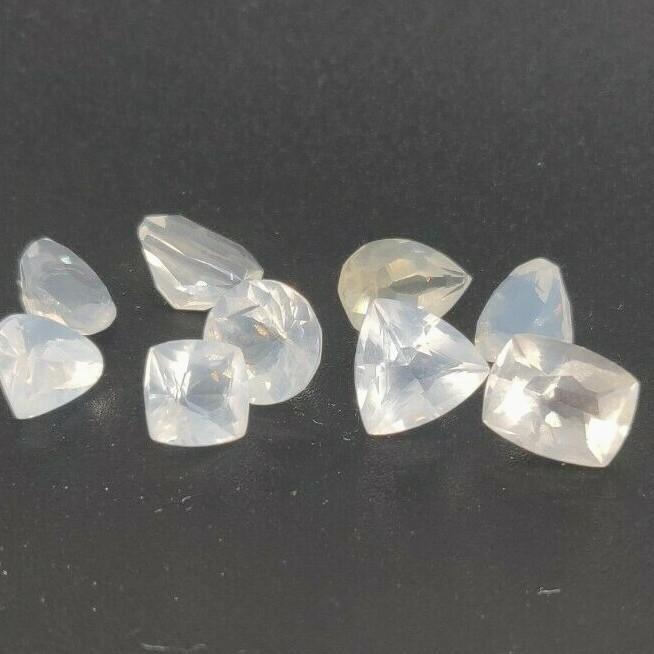
GREAT VALUE LOT 10 pc 13.00 ct WELO OPAL – MEXICO
EXPERT VERIFIED
- Expert Verified Gemstone
- Fast Handling & Shipping
- Secure Vault Packaging
$ 170 Original price was: $ 170.$ 102Current price is: $ 102.
Offer amount Feild


Smart Collector Choice


Pay with Crypto & Get 10% Automatic Discount

Availability: 1 in stock
- Freakingcats Gemstone Database
Welo Opal from Mexico represents a fascinating "geological cross-pollination" within the opal world. While the "Welo" trade name is synonymous with Ethiopia, certain volcanic deposits in Mexico—particularly in the highlands of Querétaro—produce a specific variety of hydrophane opal that mimics the "Welo style" of transparency and neon-bright play-of-color. I have always admired these Mexican "Welo-types" for their structural resilience and their ability to host a "fire" that seems to float in a water-clear matrix. For the specialist, a Mexican specimen of this caliber is a prize of volcanic purity; it bridges the gap between the traditional "Cantera" fire opals and the modern, high-translucency African giants. It is a stone of "liquid light," offering a kaleidoscopic brilliance that is as grounded as the Mexican earth and as ethereal as a summer cloud.
The Heritage & DiscoveryHistorical Significance: Mexico has been the heart of opal mining in the Americas since the time of the Aztecs, who called the stone vitzitziltecpatl (hummingbird stone). Historically, most Mexican opals were known for their warm, orange "fire" body colors. In the world of fine minerals, the emergence of "crystal-grade" hydrophane material that rivals Welo standards is a testament to the diversity of the Mexican Volcanic Belt. It stands as a symbol of endurance and heritage, bridging the gap between ancient Mesoamerican tradition and the elite world of "phenomenal" 21st-century gemology. It serves as a reminder that the volcanic heart of Mexico still holds many secrets, capable of producing "Welo-style" wonders in its own high-altitude rhyolite beds.
Discovery: The discovery of these specific "clear-fire" opals often occurs in the Magdalena and Querétaro regions. Scientifically, it is a hydrated amorphous silica formed within the cavities of rhyolitic lavas. Its discovery provided mineralogists with a clear look at how volcanic hydrophane can develop independently across different continents. My own respect for this material grew from observing how the Mexican matrix often provides a more stable "host" for the silica spheres, sometimes resulting in a stone that is less prone to the "crazing" seen in lesser African specimens. Since its identification, it has become a "secret favorite" for the connoisseur who wants the Welo look with a Mexican pedigree.
Important Mines: The legendary source for this specific variety is the Santa Maria del Iris and La Carbonera mines in Querétaro, Mexico. These sites are world-renowned for their "crystal" opals that exhibit a full spectral play-of-color. For the vault, I prioritize specimens that are "water-clear" (free of milky cloudiness) and show a "Contra-Luz" effect—where the play-of-color is most visible when light passes through the stone from behind, creating a spectacular internal aurora.
Mineralogical ProfileDescription: Mexican Welo-type Opal is a hydrated amorphous silica. It sits at a 5.5 to 6.5 on the Mohs scale. Like its Ethiopian namesake, much of this material is hydrophane, meaning its appearance can change based on its hydration level. It is characterized by its vitreous luster and its exceptional transparency.
One of its most identifying traits is its body clarity—the silica spheres are arranged so perfectly that the stone acts as a clear window, only revealing its "fire" when the light hits at the correct angle. It has a low refractive index ($n \approx 1.37$ to $1.47$) and a characteristic lightness ($SG \approx 1.9$ to $2.1$). Because it is a volcanic product, it is almost always found in association with Rhyolite. When I select a piece for the collection, I look for "360-degree" color coverage and a lack of surface-reaching fractures, as these highlight the sophisticated, three-dimensional geometry of the silica structure. It is a light, high-vibration mineral that offers a unique, "liquid" beauty unlike any other opal variety.
Chemical Formula: SiO2·nH2O
Related products
- Sale!Suggest a Price
![1.05 ct ANHYDRITE - MEXICO]()
- Sale!Suggest a Price
![1.48 ct ANDALUSITE - BRAZIL]()
- Sale!Suggest a Price
![1.63 ct CATS EYE ALEXANDRITE - INDIA]()
- Sale!Suggest a Price
![12.90 ct AMAZONITE - USA]()


