

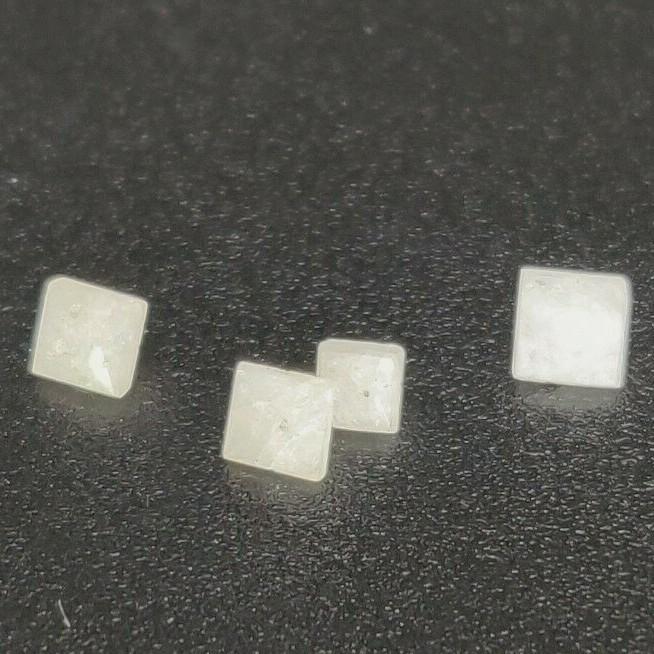
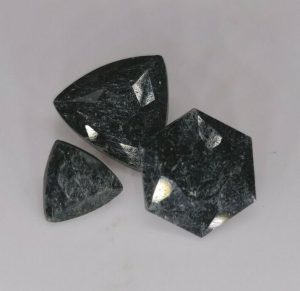
VALUE LOT 4 pc 0.50 ct RHODIZITE – MADAGASCAR
EXPERT VERIFIED
- Expert Verified Gemstone
- Fast Handling & Shipping
- Secure Vault Packaging
$ 160 Original price was: $ 160.$ 96Current price is: $ 96.
Offer amount Feild


Smart Collector Choice


Pay with Crypto & Get 10% Automatic Discount

Availability: 1 in stock
- Freakingcats Gemstone Database
Rhodizite is a gemstone that I consider one of the true "heavyweights" of the rare mineral world, despite its typically small size. A complex potassium cesium beryllium aluminum borate, it is famous among collectors for being one of the most chemically sophisticated minerals on Earth. I have always been captivated by its "diamond-like" personality; it possesses a high refractive index and a vitreous to adamantine luster that gives faceted stones an incredible, crisp brilliance. It is a stone of intense energy, often found as sharp, dodecahedral crystals in the heart of granitic pegmatites. For the collector, Rhodizite is a masterclass in rare-element chemistry—a tiny, glassy powerhouse that represents the absolute final, most concentrated stage of a pegmatite's life.
The Heritage & DiscoveryHistorical Significance: Rhodizite has a long and storied history as a mineralogical rarity. Historically, it was first found in the Ural Mountains of Russia, where it was so rare that it was considered a "mythical" find for decades. It represents a specific geochemical "extreme" where beryllium, boron, and rare alkalis like cesium and rubidium are forced into a singular, tight crystal lattice. In the world of fine minerals, it is celebrated for its unique ability to "glow" under a blowpipe (a property known as its "fusibility"), which earned it its name. It stands as a symbol of the rare-element concentration that can only occur in the most evolved pegmatite systems in the world.
Discovery: The mineral was first described in 1834 by the German mineralogist Gustav Rose based on specimens from the Ural Mountains, Russia. Its name is derived from the Greek word rhodizein, meaning "to rose," because it colors a flame rose-red during chemical testing. Scientifically, it forms a series with its more cesium-rich cousin, Londonite. Its discovery was vital for understanding how the Earth’s most elusive elements are partitioned during the final stages of magmatic cooling.
Important Mines: While it was discovered in Russia, the undisputed modern source for the world's finest gem-quality crystals is the Antsirabe and Betafo regions of Madagascar. Specifically, the Sahatany Valley is legendary for producing sharp, transparent crystals. I also have a high regard for the historic, though rarely seen, material from the Urals. For the vault, I prioritize the Madagascar crystals for their exceptional transparency and the "Londonite-Rhodizite" hybrids for their unique, high-cesium chemistry and superior brilliance.
Mineralogical ProfileDescription: Rhodizite is a potassium cesium beryllium aluminum borate that crystallizes in the isometric (cubic) system. It sits at a 8 on the Mohs scale, making it exceptionally hard and durable—ranking right alongside Topaz and just below Sapphire. It is characterized by its vitreous to adamantine luster and its typically colorless, pale yellow, or light green appearance.
One of its most identifying traits is its extreme chemical complexity. It is one of the few minerals that naturally concentrates cesium and rubidium. It has a high refractive index ($n \approx 1.69$), which provides a sharp, "snappy" brilliance when faceted. Because it is isometric, it is singly refractive, which adds to the clarity and "pure" look of the gem. When I facet Rhodizite, I treat it with the same respect as a diamond or sapphire; its hardness allows for incredibly sharp facet junctions, resulting in a stone that pulses with light. It is a dense, "technically perfect" mineral that remains a crown jewel for any specialist in rare-element species.
Chemical Formula: (K,Cs)Al4Be4(B11Be)O28
Related products
- Sale!Suggest a Price
![1.05 ct ANHYDRITE - MEXICO]()
- Sale!Suggest a Price
![1.25 ct ANDALUSITE - BRAZIL]()
- Sale!Suggest a Price
![LOT 6.90 ct AFGHANITE - UV Colorchange]()
LOT 6.90 ct AFGHANITE – UV Colorchange
$ 240Original price was: $ 240.$ 144Current price is: $ 144. - Sale!Suggest a Price
![9.05 ct 3 pc AERINITE - SPAIN]()


