
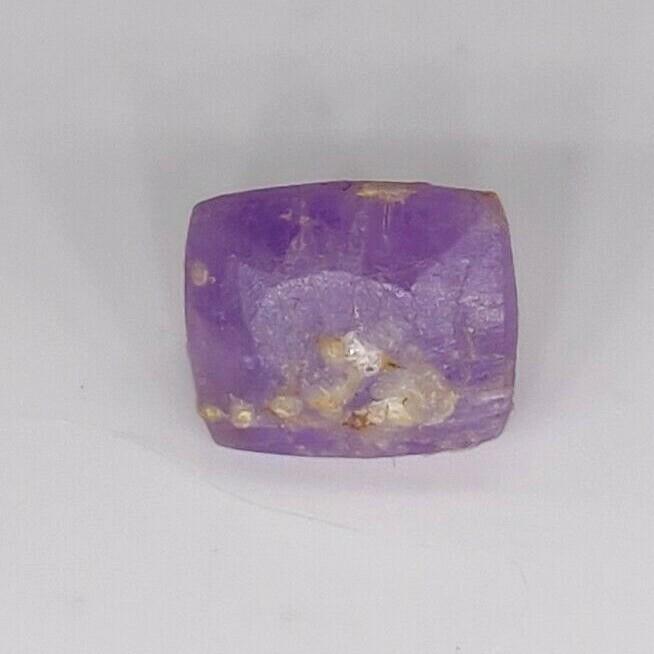
0.95 ct COQUIMBITE – PERU
EXPERT VERIFIED
- Expert Verified Gemstone
- Fast Handling & Shipping
- Secure Vault Packaging
$ 350
Offer amount Feild


Smart Collector Choice


Pay with Crypto & Get 10% Automatic Discount

Availability: 1 in stock
- Freakingcats Gemstone Database
Coquimbite represents the "delicate lilac" essence of the ferric sulfate world. A hydrated iron sulfate, it is a species I have always respected for its ethereal, pastel coloration—ranging from a soft "lavender" to a vibrant "grape-juice" purple. For the specialist, Coquimbite is a prize of secondary geochemical concentration; it forms primarily in the oxidized zones of iron-rich sulfide deposits in extremely arid climates. It typically presents as granular masses or, in rare and exceptional cases, as sharp, hexagonal prisms with a vitreous luster. It is a stone of "evaporative beauty," providing a sophisticated, high-frequency aesthetic that makes it a true "ephemeral treasure" for the systematic vault.
The Heritage & DiscoveryHistorical Significance: Coquimbite is a vital species for understanding the complex dehydration and oxidation sequences of iron-bearing minerals in desert environments. Historically, it was a rare discovery that captivated early mineralogists with its unique "amethyst-mimicking" hue in a sulfate structure. In the world of fine minerals, it is celebrated for its sensitivity to humidity; because it is a hydrated species, it stands as a symbol of the delicate balance between the mineral and its atmosphere. It bridges the gap between common iron oxides and the elite world of "water-soluble" collector rarities, serving as a reminder that some of the Earth's most beautiful colors are born from the drying of ancient, mineral-rich waters.
Discovery: The mineral was formally named in 1841 by August Breithaupt. The name is derived from its type-locality: the Coquimbo Province in Chile. Scientifically, it is a ferric iron sulfate. Its discovery provided mineralogists with the first clear look at how iron can be sequestered in a stable, hexagonal lattice without the presence of oxygen-rich oxides like Hematite. My own respect for this material grew from observing its "gemmy" transparency; in rare, well-crystallized specimens, the light passes through the lilac structure with a clarity that rivals the finest precious gems.
Important Mines: The undisputed world capital for the finest, most vibrant "lilac" Coquimbite is the Javier Mine in the Huancavelica Department, Peru. These Peruvian specimens set the global benchmark for crystal size and color saturation. I also have a high regard for the classic, historic material from the Chuquicamata Mine in Antofagasta, Chile, and the rare occurrences in the Tierra Amarilla district. For the vault, I prioritize the Peruvian material for its "neon-purple" intensity and its exceptional crystalline habit.
Mineralogical ProfileDescription: Coquimbite is a hydrated iron sulfate that crystallizes in the trigonal (hexagonal) system. It sits at a 2 to 2.5 on the Mohs scale, making it an extremely soft and delicate mineral that must be protected from physical contact and high humidity. It is characterized by its vitreous luster and its unmistakable range of "violet" and "lilac" colors.
One of its most identifying traits is its solubility in water and its astringent taste—though as an expert, I advise against tasting specimens to preserve their integrity. It has a moderate refractive index ($n \approx 1.54$ to 1.56) and a relatively light specific gravity ($SG \approx 2.1$). Because it is an oxidation-zone mineral, it is often found in association with Römerite, Copiapite, and Voltaite. When I select a piece for the collection, I look for "sharp" hexagonal outlines and a lack of the "white powdery" dehydration (Paracoquimbite) that can occur over time, as these highlight the sophisticated, three-dimensional geometry of the mineral's growth. It is a light, high-vibration mineral that offers a unique, "aqueous-lilac" beauty unlike any other sulfate species.
Chemical Formula: Fe3+2(SO4)3·9H2O


