
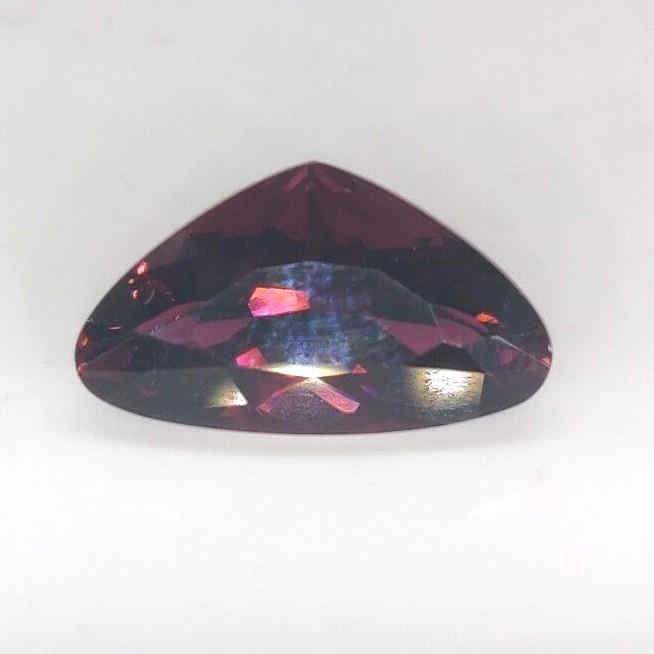
4.38 ct RHODOLITE GARNET – BRAZIL
EXPERT VERIFIED
- Expert Verified Gemstone
- Fast Handling & Shipping
- Secure Vault Packaging
$ 160
Offer amount Feild


Smart Collector Choice


Pay with Crypto & Get 10% Automatic Discount

Availability: 1 in stock
- Freakingcats Gemstone Database
Rhodolite Garnet represents the "velvety bridge" of the garnet group. It is a mineral I have always respected for its sophisticated, "raspberry" hue—a unique color profile that exists exactly at the intersection of the pyrope and almandine series. The name is derived from the Greek rhodon, meaning "rose," which perfectly describes its signature purplish-red to rose-red glow. For the specialist, Rhodolite is a prize of optical balance; it lacks the dark, "inky" saturation of pure Almandine and the "fiery" orange-red of pure Pyrope, offering instead a cool, vibrant brilliance. It is a stone of "composed passion," providing a high-clarity, high-frequency aesthetic that makes it a timeless staple for the systematic vault.
The Heritage & DiscoveryHistorical Significance: Rhodolite was first identified as a distinct variety in the late 19th century in North Carolina. Historically, it was favored as a more vibrant alternative to the dark "Bohemian" garnets of the era. In the world of fine minerals, it is celebrated for its natural brilliance; unlike many modern gemstones, Rhodolite is never treated or heated, standing as a symbol of geological purity. It bridges the gap between common metamorphic garnets and the elite world of "neon" precious stones, serving as a reminder that some of the most beautiful colors in nature are found in the subtle mixing of two distinct mineral species.
Discovery: The variety was famously documented in 1898 by William Earl Hidden (for whom Hiddenite is named) in the Cowee Valley of North Carolina. Scientifically, it is a mixture of Pyrope and Almandine, usually in a ratio of 2:1. Its discovery provided mineralogists with a clear look at how solid-solution series can produce distinct, stable varieties with unique optical properties. My own respect for this material grew from observing its behavior under different light sources; it often maintains its "raspberry" vividness even in evening light, a trait that makes it a favorite for the connoisseur who values "life" in a gemstone.
Important Mines: While the historic mines of North Carolina are legendary, the undisputed modern capital for the finest, most vibrant Rhodolite is the Umba Valley in Tanzania. I also have a high regard for the spectacular, "grape-colored" material from Sri Lanka and the high-quality stones found in Madagascar and the Kangayam region of Tamil Nadu. For the vault, I prioritize the "Umba" material for its unmatched purplish-rose saturation and the Sri Lankan stones for their exceptional "water-clear" transparency.
Mineralogical ProfileDescription: Rhodolite is a magnesium-iron aluminum silicate that crystallizes in the isometric (cubic) system. It sits at a 7 to 7.5 on the Mohs scale, making it an incredibly durable and tough gemstone, perfectly suited for heavy wear. It is characterized by its vitreous luster and its range of "rose-red," "raspberry," and "plum" colors.
One of its most identifying traits is its lack of iron-driven "blackness"; even in larger sizes, a top-tier Rhodolite remains transparent and bright. It has a high refractive index ($n \approx 1.75$ to $1.76$) and a significant specific gravity ($SG \approx 3.7$ to $3.9$). Because it is a product of regional metamorphism, it is often found in association with Sillimanite, Kyanite, and Biotite. When I select a piece for the collection, I look for "even" purplish-red distribution and a lack of the "sugar" (fine crystal) inclusions that can occasionally occur, as these highlight the sophisticated, three-dimensional geometry of the garnet structure. It is a dense, high-vibration mineral that offers a unique, "velvety" beauty unlike any other garnet variety.
Chemical Formula: (Mg,Fe)3Al2(SiO4)3


