
SKU: OPAL0001
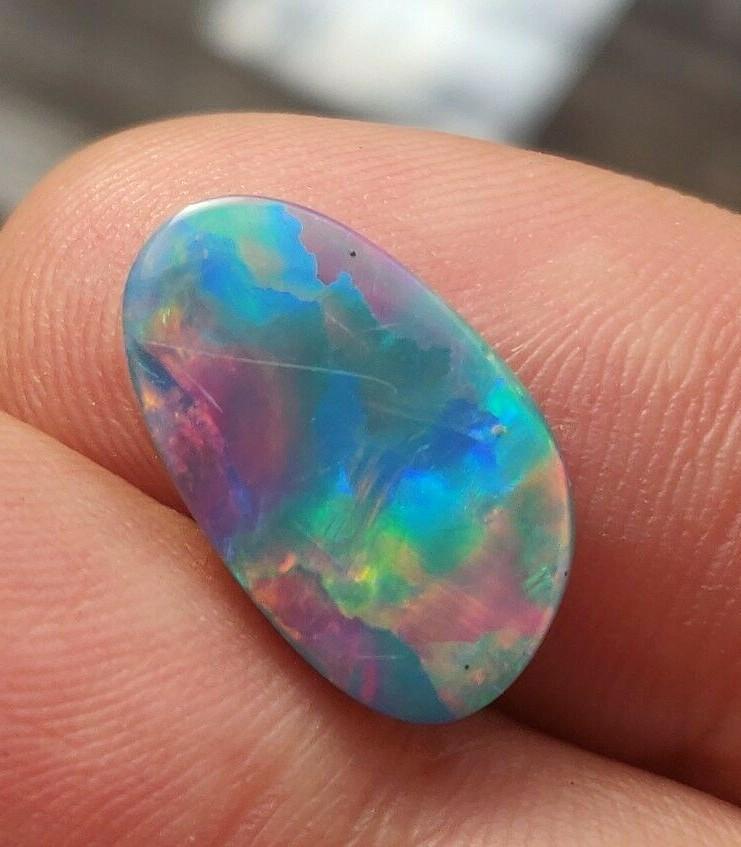
4.30 ct SPECTACULAR BRIGHTEST COLORS DOUBLET OPAL – AUSTRALIA
EXPERT VERIFIED
- Expert Verified Gemstone
- Fast Handling & Shipping
- Secure Vault Packaging
$ 500
Offer amount Feild


Smart Collector Choice


Pay with Crypto & Get 10% Automatic Discount

Availability: 1 in stock
Gemstone Details
Gem Variety:
Opal Doublet
Origin:
Australia
Carat Weight:
4.30
Length (mm):
16.3
Width (mm):
9.7
Depth (mm):
2.7
Shape:
Oval
Color
Multicolor
Treatment:
No treatment
Certificate:
On Request
- Freakingcats Gemstone Database
Australian Opal Doublet The Australian Opal Doublet represents the "art of enhancement" in the mineral world. It is a composite gemstone I have always respected for its ability to bring the "electrifying" play-of-color found in thin layers of precious opal to life with the intensity of a solid Black Opal. A doublet consists of a natural slice of precious Light or Crystal Opal that is meticulously bonded to a dark backing—usually black industrial glass, ironstone, or common "potch" opal. For the specialist, the doublet is a study in contrast; the dark backing acts as a "canvas" that allows the spectral colors of the opal layer to "pop" with a neon-like brilliance. It is a gemstone of engineering and aesthetics, offering the visual depth of the world's rarest opals while remaining more accessible for the daily vault. The Heritage & Discovery Historical Significance: The creation of doublets is a vital part of the Australian gem-cutting tradition. Historically, as miners in the outback discovered that much of the highest-quality "play-of-color" occurred in veins too thin to be cut as solid stones, they developed the doublet technique to preserve and showcase this beauty. In the world of fine minerals, a high-quality doublet is celebrated for its optical deception; when set in jewelry, it is often indistinguishable from a solid Black Opal. It stands as a symbol of resourcefulness, bridging the gap between raw, fragile seams of color and the elite world of "high-impact" wearable gems. It serves as a reminder that the most vibrant colors in nature sometimes require a dark shadow to truly shine. Discovery: The primary material for these doublets is discovered in the ancient, "Cretaceous" sedimentary basins of the Australian interior. Scientifically, the opal layer is a hydrated amorphous silica. The discovery of the "doublet technique" allowed the industry to utilize the spectacular "seam opal" that would otherwise be lost. My own respect for this material grew from observing how the dark backing changes the refractive perception of the stone; it absorbs the light that would otherwise pass through a transparent opal, forcing it to reflect back through the silica spheres and intensifying the spectral flash. Since their introduction, doublets have become a staple for those who prioritize "maximum color" and "visual fire." Important Mines: The legendary sources for the precious opal used in these doublets are Coober Pedy and Andamooka in South Australia, as well as the Lightning Ridge fields in New South Wales. For the vault, I prioritize doublets that use Ironstone as a backing (sometimes called a "natural doublet"), as this provides a more organic feel and better structural stability than synthetic glass or plastic backings. Mineralogical Profile Description: An Australian Opal Doublet is a composite of a Precious Opal layer (Mohs 5.5–6.5) and a dark supporting substrate. Because it is a "joined" stone, it requires careful handling; it should never be submerged in water for long periods, as this can weaken the bonding agent. It is characterized by its vitreous luster on the surface and its intense, "masked" play-of-color. One of its most identifying traits is the "join line"—when viewed from the side, a clear, straight boundary can be seen between the colorful opal and the dark backing. It has a low refractive index ($n \approx 1.44$ to $1.46$) within the opal layer. Because the opal is thin, the "fire" often appears more concentrated and "flat" compared to the three-dimensional "rolling" flash of a thick solid crystal. When I select a piece for the collection, I look for a "perfectly flat" join and a color layer that is free of "dead spots" (potch), as these represent the species in its most aesthetic and high-impact form. Chemical Formula: SiO2·nH2O (Opal Layer)


