
SKU: TEKT0030
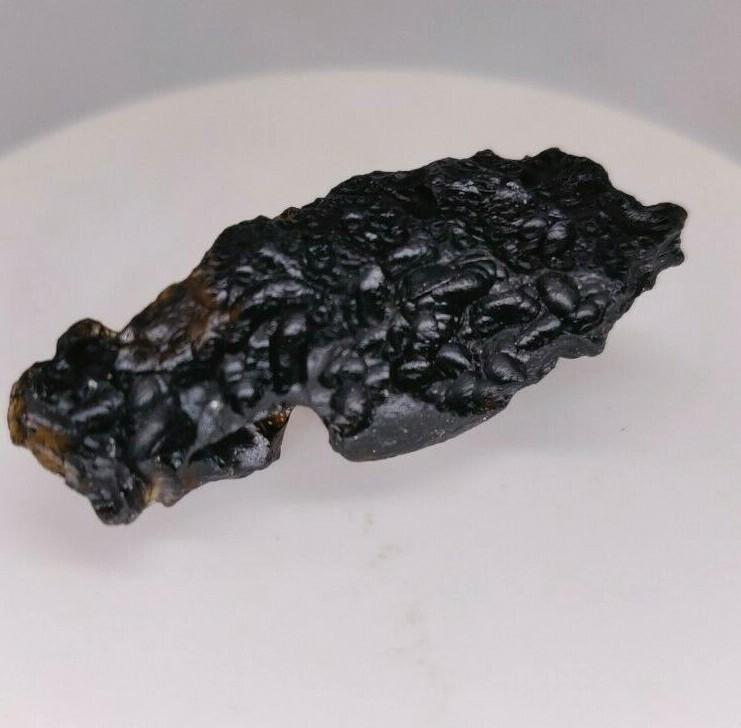
7.32 g INDOCHINITE TEKTITE – INDOCHINA
EXPERT VERIFIED
- Expert Verified Gemstone
- Fast Handling & Shipping
- Secure Vault Packaging
$ 200
Offer amount Feild


Smart Collector Choice


Pay with Crypto & Get 10% Automatic Discount

Availability: 1 in stock
Gemstone Details
Gem Variety:
Indochinite Freak Shape
Origin:
Indochina
Carat Weight:
36.6
Length (mm):
39
Width (mm):
17.2
Depth (mm):
14.6
Shape:
Oval
Color
Black
Treatment:
No Treatment
Certificate:
On Request
- Freakingcats Gemstone Database
Indochinite Tektite Indochinite tektites are black, strange, and I love them. They used to be common here in Asia, and I happily bought large pieces, mostly in the classic round or teardrop shapes. I never thought I would become totally obsessed with them until I noticed something super, super ultra-rare among the masses: "Freak Shapes," as I call them. These are pieces of ground material that were instantly superheated by a massive meteorite strike, mixed with celestial remains, and thrown into the upper atmosphere like blobs of liquid glass. As they rained back down, some were distorted by extreme atmospheric forces, creating crazy, one-of-a-kind shapes. I shifted through tons of material to find these rare collector items, each one a frozen moment of a prehistoric cosmic catastrophe. The Heritage & Discovery Historical Significance: Indochinites are part of the largest tektite strewn field on Earth—the Australasian strewn field—which covers about 10% of the planet's surface. Historically, they were a mystery; for a long time, people debated whether they were volcanic or even lunar in origin. We now know they are terrestrial silica that was flash-melted by a meteorite impact approximately 788,000 years ago. They represent a bridge between geology and astronomy, serving as a physical reminder of the violent events that have shaped our planet’s history. Discovery: The term "Indochinite" refers to tektites found across the Indochinese peninsula, including Thailand, Laos, Vietnam, and Cambodia. While they have been known to local populations for centuries, they were first brought to the attention of the global scientific community in the early 20th century. The sheer volume of the Indochinite find has allowed us to study the "ablation" process—how glass melts and reforms as it travels through the atmosphere at hypersonic speeds. Important Mines: Because tektites are part of a "strewn field," they aren't mined in traditional veins but are recovered from the surface or within shallow soil layers. Significant deposits are found throughout Thailand, particularly in the Khorat Plateau, as well as in Vietnam and Southern China. I have spent years sourcing from these regions, specifically looking for the "freak shapes"—dumbbells, elongated sticks, and twisted "splash" forms—that escaped the more common aerodynamic rounding process. Mineralogical Profile Description: Indochinite is a high-silica glass, sitting at a 5.5 to 6.5 on the Mohs scale. It is characterized by its deep, opaque black color, though thin edges can sometimes show a translucent tea-brown or olive-yellow hue when held to strong light. The surface is often pitted with "cupules"—tiny craters caused by gas bubbles or atmospheric etching. Unlike volcanic obsidian, tektites are remarkably dry, containing almost no water. This lack of water, combined with the presence of "lechatelierite" (melted quartz), proves their high-temperature impact origin. When I find a "freak shape," the internal flow lines and distorted geometry tell the story of a molten blob spinning and cooling in mid-air before slamming back into the earth. Chemical Formula: Primarily SiO2 (approx. 70-75%) with oxides of Al, Fe, Mg, Ca, Na, and K.


