

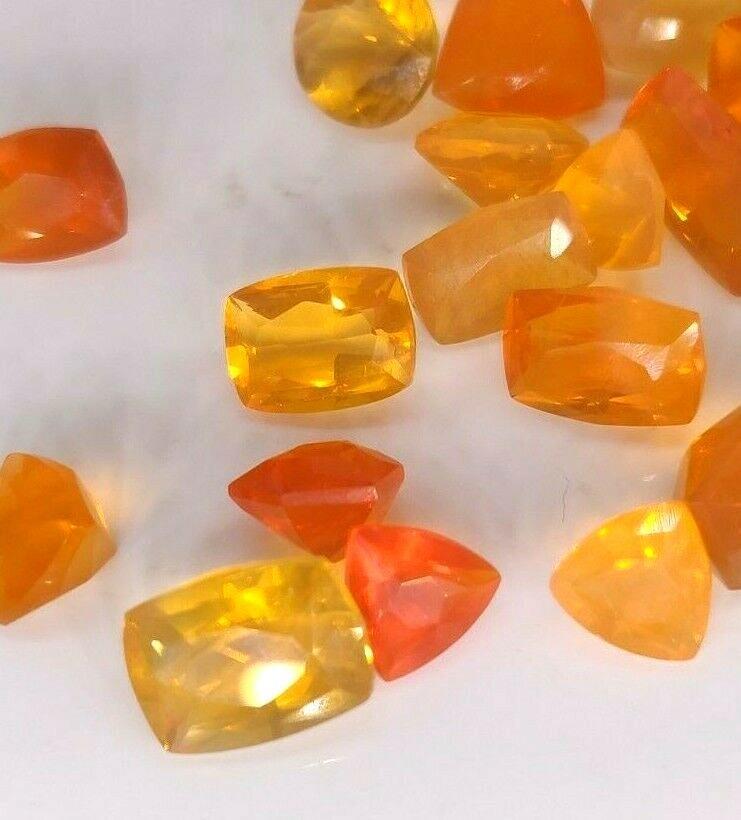
GREAT VALUE LOT 22 pcs 22.30 ct WELO OPAL – ETHIOPIA
EXPERT VERIFIED
- Expert Verified Gemstone
- Fast Handling & Shipping
- Secure Vault Packaging
$ 200 Original price was: $ 200.$ 120Current price is: $ 120.
Offer amount Feild


Smart Collector Choice


Pay with Crypto & Get 10% Automatic Discount

Availability: 1 in stock
- Freakingcats Gemstone Database
Welo Opal represents the "electric" modern era of the opal world. Emerging from the high-altitude plateaus of Ethiopia, it is a mineral I have always admired for its incredible "play-of-color" and its unique hydrophane nature—the ability to absorb water and shift from opaque to translucent. Unlike the sedimentary opals of Australia, Welo Opal is volcanic in origin, born from silica-rich fluids filling the cavities of ancient rhyolite. For the specialist, a top-tier Welo specimen is a prize of "three-dimensional" fire; the colors often appear suspended deep within the stone in patterns like "honeycomb," "digit-pattern," or "rolling flash." It is a gemstone of high-energy vibrance, offering a kaleidoscopic brilliance that feels almost digital in its intensity.
The Heritage & DiscoveryHistorical Significance: While Ethiopia is one of the oldest inhabited places on Earth, the Welo deposit is a relatively recent "miracle" in gemology. Historically, African opals were known from the Shewa province (the "chocolate" opals), but they were prone to cracking. In the world of fine minerals, the 2008 discovery of the Welo field changed everything, providing a stable, high-clarity alternative to the Australian monopoly. It stands as a symbol of renewal and hidden treasures, bridging the gap between ancient volcanic basalt and the elite world of "phenomenal" precious stones. It serves as a reminder that the Earth still holds massive, undiscovered "vaults" of beauty waiting for the right moment to be revealed.
Discovery: The field was officially discovered in the Wegel Tena region of the Wollo (Welo) Province. Scientifically, it is a hydrated amorphous silica. Its discovery provided mineralogists with the first clear look at a volcanic opal that possessed the stability and transparency required for high-end faceting. My own respect for this material grew from its "chameleon" quality; a piece can look like a simple white stone until it is wet or held to the light, at which point it "ignites" with every color of the spectrum. Since its identification, it has become the most significant opal discovery of the 21st century.
Important Mines: The undisputed world capital for this material is the Wegel Tena area, where miners excavate the opal-bearing layers from steep mountain cliffs. For the vault, I prioritize "crystal" grade specimens that exhibit the "Honeycomb" pattern—a rare hexagonal cell structure of color—as these represent the peak of Welo's unique geological formation.
Mineralogical ProfileDescription: Welo Opal is a hydrated amorphous silica that lacks a formal crystal system. It sits at a 5.5 to 6.5 on the Mohs scale. Its defining characteristic is its hydrophane property; because it is porous, it can absorb water, temporarily changing its refractive index and transparency. It is characterized by its vitreous luster and its remarkably clear to milky-white body color.
One of its most identifying traits is its extreme color saturation. Unlike many opals that show color only on the surface, Welo Opal often has "broad-fire" that permeates the entire stone. It has a low refractive index ($n \approx 1.40$ to $1.46$) and a characteristic lightness. Because it is a volcanic product, it is often found in association with Rhyolite and Obsidian. When I select a piece for the collection, I look for "body-tone" clarity and a "rolling" flash that covers the entire stone without "dead spots," as these highlight the sophisticated, three-dimensional geometry of the silica spheres. It is a light, high-vibration mineral that offers a unique, "celestial" beauty unlike any other opal variety.
Chemical Formula: SiO2·nH2O
Related products
- Sale!Suggest a Price
![1.25 ct ANDALUSITE - BRAZIL]()
- Sale!Suggest a Price
![14.30 ct 2 pc AERINITE - SPAIN]()
- Sale!Suggest a Price
![2.52 ct AMAZONITE - USA]()
- Sale!Suggest a Price
![0.60 ct ANATASE - AUSTRALIA]()


