

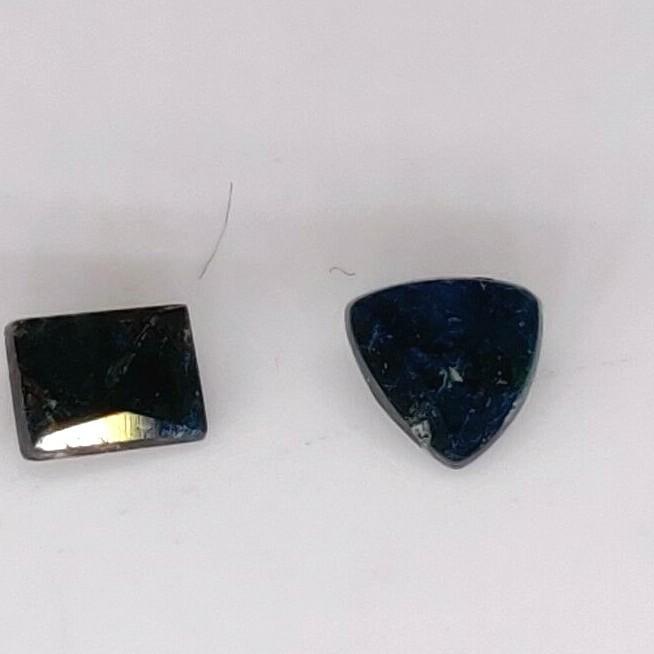
LOT 2 pc 0.25 ct KULANITE – CANADA
EXPERT VERIFIED
- Expert Verified Gemstone
- Fast Handling & Shipping
- Secure Vault Packaging
$ 100 Original price was: $ 100.$ 60Current price is: $ 60.
Offer amount Feild


Smart Collector Choice


Pay with Crypto & Get 10% Automatic Discount

Availability: 1 in stock
- Freakingcats Gemstone Database
Kulanite is a gemstone that speaks to the absolute rarity of the Yukon’s frozen peaks. A rare barium iron aluminum phosphate, it is one of those "collector’s secrets" that I find endlessly fascinating. It often presents in a deep, moody forest green to a dark, blackened blue, possessing a vitreous luster that gives it a sharp, professional finish. When I first encountered Kulanite, I was struck by its density and the way its color seems to shift between green and blue depending on the light—a characteristic pleochroism that is a hallmark of the species. Finding gem-quality crystals is a true feat, as they are typically small and tucked away in the cracks of iron-rich formations. For the connoisseur, owning a faceted Kulanite is like owning a fragment of the most remote geological frontiers on Earth.
The Heritage & DiscoveryHistorical Significance: Kulanite belongs to a specialized group of phosphates that formed in the unique, phosphate-rich ironstones of the far north. Historically, it has been a significant discovery for Canadian mineralogy, representing the chemical complexity of the Big Fish River area. It is a mineral of the "Bjarebyite group," signifying a rare geological moment where barium and phosphorus were concentrated in a high-pressure environment. In the world of rare gems, it is prized for its rarity and its provenance, standing as a dark, elegant representative of the "Arctic phosphates" that are so highly sought after by mineralogists worldwide.
Discovery: The mineral was first described in 1976 and was named in honor of Alan Kulan (1921–1977), a legendary prospector who was instrumental in discovering many of the rare phosphate localities in the Yukon Territory. His dedication to exploring the rugged wilderness led to the identification of several new species, and naming this beautiful, dark green phosphate after him ensures his legacy remains as enduring as the rocks he discovered.
Important Mines: The legendary and undisputed type-locality for Kulanite is the Big Fish River/Rapid Creek area in the Dawson mining district of the Yukon, Canada. This remote, sub-arctic region is the only source that has produced crystals of significant size and quality for the gem market. I also look toward the Cross Lake area in Manitoba for mineralogical specimens. I prioritize the Yukon material for the vault, as its sharp, tabular crystals and deep saturation are the absolute standard for the species, representing the very best of Canadian rare-stone heritage.
Mineralogical ProfileDescription: Kulanite is a barium iron aluminum phosphate that crystallizes in the monoclinic system. It sits at a 4 on the Mohs scale, making it a delicate gem that is best reserved for specialized collections and protected displays. It is characterized by its vitreous luster and its typically deep green to blue-green color.
One of its most identifying traits is its strong pleochroism, where the stone can appear emerald green, brownish-green, or deep blue when viewed from different angles. It typically forms as small, tabular crystals or as inclusions within other phosphates. Because of its barium content, it is surprisingly dense for a phosphate mineral ($3.9$ to $4.0$ g/cm³). When faceted, it has a high refractive index ($n \approx 1.70$ to $1.72$), which provides a surprisingly bright surface brilliance for such a dark-colored stone. It is a sophisticated, "intellectual" mineral that captures the cold, pristine energy of the Canadian north.
Chemical Formula: Ba(Fe2+,Mn,Mg)2Al2(PO4)3(OH)3
Related products
- Sale!Suggest a Price
![0.75 ct ANTHRACITE - USA]()
- Sale!Suggest a Price
![0.42 ct ANATASE - AUSTRALIA]()
- Sale!Suggest a Price
![14.30 ct 2 pc AERINITE - SPAIN]()
- Sale!Suggest a Price
![12.90 ct AMAZONITE - USA]()


